Congers,
New York
Bus/Train
collision
March 1972
The
train-bus crashes in Spring City, Tennessee and Evans, Colorado
inspired the legislative bodies in all 50 states to make huge strides
in school bus safety legislation. By 1972 drivers in all states were
required not only by law, but by Federally mandated State law, to stop
at all railroad crossings, be they signaled or non-signaled,
then actually look and listen for a train. We’re talking stop the
bus, open the door and driver's window, quiet the kids down, turn off
anything that makes noise, and really look and listen for a
train. Some school districts went a step further and required
an aide or older student to actually ‘Walk the crossing’ to check
for a train. In theory, if everyone did what they were supposed to
do, no school bus should've ever again been hit by a train…but unfortunately we all
know that people have a bad habit of doing the exact opposite
of what they’re supposed to do.
With
that fact in mind, one of two things that the laws hadn't
addressed by 1972 was the simple fact that the buses we rode back in the
Sixties and Seventies weren't all that well built. Then as now
school districts were on a budget and pinched pennies so hard that
they had ol’ Honest Abe’s profile impressed into their collective
thumbs. The bus manufacturers knew this, and knew that these
same districts would purchase the least expensive vehicles available because of the
infamous Lowest Bid Concept, which is still in practice today and
will still be in practice when our grand kids and great grand-kids are collecting Social
Security. School districts ( And Government entities in general) purchase the least expensive item available, and they determine which item is least expensive by advertising for vendors to submit bids. The vendor who charges the least for the item or service wins. Trust me on this, as little as ten or twenty
dollars per unit could make the difference between a bid being
accepted or rejected, so the bus manufacturers cut corners where ever
they could to get the price-per-vehicle down in order to submit the lowest bid. And far, far too often the
corners that were cut involved construction materials and methods.
Bus bodies were built of separate steel panels riveted together, with external 'rub rails' running the length of the body added to increase rigidity. More rigidity was added by the vehicle frame. The body itself generally had only a very rudimentary framing system whose main function was to help the bus body hold it's shape, with almost all of it's rigidity and crash-worthiness provided by the rub rails and vehicle frame. Wait, did I say 'crash-worthiness'?? Maybe in a low speed, front or rear collision with something smaller then the bus. Generally, though, school buses of that era did not handle either rolling over or getting hit broadside by something bigger then they were well at all. They had an unfortunate tendency to come apart when either event occurred.
Bus bodies were built of separate steel panels riveted together, with external 'rub rails' running the length of the body added to increase rigidity. More rigidity was added by the vehicle frame. The body itself generally had only a very rudimentary framing system whose main function was to help the bus body hold it's shape, with almost all of it's rigidity and crash-worthiness provided by the rub rails and vehicle frame. Wait, did I say 'crash-worthiness'?? Maybe in a low speed, front or rear collision with something smaller then the bus. Generally, though, school buses of that era did not handle either rolling over or getting hit broadside by something bigger then they were well at all. They had an unfortunate tendency to come apart when either event occurred.
The
other thing that hadn't been addressed...consistently at any
rate...was training for drivers. Now don’t get me wrong here…the
great majority of school bus drivers were skilled and conscientious.
The bus I rode during my first year in high school was driven by a
diminutive and formidable lady named Mrs Yates who took no crap from
any of us, and who was a pro at wheeling the big 66 passenger
Ford/Wayne that was bus #169 through the winding streets and lanes of
suburban Chesterfield County, Va. But for every hundred Mrs. Yates
driving a school bus in the US, there were also one or two who
slipped through the cracks and were nowhere near as competent
or conscientious as she was. Training for school bus drivers just wasn't consistent in the
U.S nearly 43 years ago.
Depending on the state you you lived in, licensing requirements ranged from a required chauffeur's license with a specific endorsement for a school bus to no specific licensing requirements at all, other than possession of a standard drivers license in good standing. In some states, training consisted of nothing more than riding the route with a regular driver or supervisor a couple of times while in others there was a required specific curriculum with a mandated number of both classroom and behind the wheel training hours.
Background checks were often rubber-stamp affairs if they existed at all. Pay often wasn't all that good, so there tended to be a good bit of turn-over. And yes, people whose driving record shouldn't have allowed them to drive a nail did indeed occasionally end up behind the wheel of a school bus, no matter what the training requirements were. This post will bear that last point out, BTW, because New York state, where the accident covered by this post occurred, was actually among the states with fairly high training and licensing requirements.
Depending on the state you you lived in, licensing requirements ranged from a required chauffeur's license with a specific endorsement for a school bus to no specific licensing requirements at all, other than possession of a standard drivers license in good standing. In some states, training consisted of nothing more than riding the route with a regular driver or supervisor a couple of times while in others there was a required specific curriculum with a mandated number of both classroom and behind the wheel training hours.
Background checks were often rubber-stamp affairs if they existed at all. Pay often wasn't all that good, so there tended to be a good bit of turn-over. And yes, people whose driving record shouldn't have allowed them to drive a nail did indeed occasionally end up behind the wheel of a school bus, no matter what the training requirements were. This post will bear that last point out, BTW, because New York state, where the accident covered by this post occurred, was actually among the states with fairly high training and licensing requirements.
Of
course, as happens all too often in the US, neither the then very prevalent less than stellar
school bus construction or the haphazard
training requirements would change until something forced them
to change.
School
bus drivers often had another, full time job and drove a school bus
to generate some extra income. And if their ‘Day-Job’ was a job
that started at, say, 9AM, and was the sort of job that they
absolutely could not be late to, they would be under serious
pressure to finish the bus route early. And if they were running late
on the bus route, they could very well cut the kind of safety corners
that could cause the kind of incident that could very well force the
changes I mentioned above. And this is pretty much exactly
what happened.
To
take a look at the accident that caused these changes to come about
we're going back almost 43 years, to a chilly early spring
morning in 1972 in the Rockland County, New York hamlet of Congers,
New York, twenty or so miles north of New York city. It was 42
degrees and clear as groups of Nyack High School students waited at
bus stops between 7 and 8AM on that 24th day of March, '72, bundled up against the chill and wondering if the weather would
ever catch up with the calendar and warm up, even as some of them
wondered if their daily ride...bus # 596...would ever show up. The
bus was running late.
The
reason the bus was running late was a bit of sewer construction that
blocked one street and created a convoluted detour that caused 35
year old FDNY firefighter and part time school bus driver Joseph
Larkin to run his normal route backwards as well as drive several miles out of his way to complete it.
This created a problem, though, and it was a biggie. He was supposed to be on duty at his fire house at 9AM. (They are always fire houses in New York City, BTW...never fire Stations). FDNY's shift schedule has the guys working a pair of 9 hour day shifts followed by two days off, then a pair of 15 hour night shifts followed by three days off, and Larkin was due in on one of his day shifts at 9 that morning. Remember me mentioning jobs you absolutely can not be late to? Firefighter is one of them...as in if you're late the guy you are supposed to relieve will not be happy and you will be written up. This is why most fire fighters try to get to work a half hour or more early, but on this morning there was no way Larkin was going to make it in by 9AM or even particularly close to 9AM, because the sewer construction and detour put him twenty minutes or so behind schedule.
This created a problem, though, and it was a biggie. He was supposed to be on duty at his fire house at 9AM. (They are always fire houses in New York City, BTW...never fire Stations). FDNY's shift schedule has the guys working a pair of 9 hour day shifts followed by two days off, then a pair of 15 hour night shifts followed by three days off, and Larkin was due in on one of his day shifts at 9 that morning. Remember me mentioning jobs you absolutely can not be late to? Firefighter is one of them...as in if you're late the guy you are supposed to relieve will not be happy and you will be written up. This is why most fire fighters try to get to work a half hour or more early, but on this morning there was no way Larkin was going to make it in by 9AM or even particularly close to 9AM, because the sewer construction and detour put him twenty minutes or so behind schedule.
On
a normal weekday Larkin would swing the big 1967 66 passenger GMC/Carpenter that was bus 596 out of the bus yard between 6:30 and 6:45AM, and end his route roughly an hour later, sometime
between 7:30 and 7:45. That gave him plenty of time to get from Nyack
High back to the bus garage, secure the bus, get in his car, head for
The Big Apple, and be early for his 9AM shift change.. That
particular morning, however, it was nearly 8AM, and he was near the
end of his run but well north of his usual route when he swung Bus 596 onto Gilchrest Rd...part of the boundary between Congers and it's southern neighbor, Valley Cottage...and headed
east, towards N.Y. State Route 303, with 48 kids on the bus. Nyack High School was almost three miles south of them, off of 303 on Midland Ave in Nyack, another of the areas contiguous series of hamlets and villages.
 |
| Old Nyack High School...the destination that Bus 596's passengers never reached. |
Gilchrest Rd wasn't
a heavily traveled thoroughfare back in '72 by any stretch of the imagination. It
was a residential connector road that wound through a comparatively
sparsely populated section of the area, and even though it runs between a pair of major roads...Kings Highway (State Route 13) and
Country Ridge Rd (State Route 303)...Gilchrest was too narrow and crooked to be a
good cut through, so fewer than 400 cars traveled it on any given
day. About half way between Rts.13 and 303 Gilchrest crossed the Penn
Central Railroad and because of the low traffic volume the Penn
Central hadn't exactly laid out big bucks for traffic control devices...there were no lights, no bells, and no gates. Just a pair
of cross bucks and a pair of stop signs.
Of
course the lack of lights, bells, and gates was absolutely no excuse
for what was about to happen...State Law mandated that
Larkin was supposed to stop at the crossing and check for oncoming
trains, and on top of that a stop sign means just that, especially at a railroad grade crossing.
But,
as he approached the crossing that brisk 24th
of March, nearing the end of that morning's run he was not only
running late, he was fast approaching the point of no return...the
point in time where there would be no way he could make it to his
firehouse on time. So, as the kids
on bus 596 wondered if they were going to be late for home room and
first period, Larkin was getting desperate to be on the way in to New
York City.
There
were 48 teenagers on Bus 596 as they rolled east on Gilchrest. Though
the bus was, in theory, capable of carrying 66 students in 11 rows of
seats, that capacity was based on elementary school students, sitting
three to a seat. Once you hit high school, three to a seat often not only redefines the concept of 'crowded', it could be downright awkward, so usually two kids grabbed each
seat, with several more...seven of them on this particular morning...standing.
This group of 48 teens included the usual eclectic and slowly awakening group of kids that could be found at 7:50 or thereabouts on any given morning aboard any school bus in the country. One young lady on Bus 596 that morning was a little bundle of nerves because she was waiting to see if she'd made the cut for the lead role in NHS' Spring Play. Another had made the bus by the skin of her teeth only because her mom hadn't made her change out of slacks and into a skirt. One of The Nyack High Indians' premiere athletes was on board, a young man who was very much a jack of all trades, sports-wise. He was taking to a friend of his who wanted to go to West Point. And so it went...forty-eight kids who's main focus at nearly 8 AM that morning was...well, teenager stuff. Not a major care in the world. And as they rolled towards the crossing, all of them heard it...
This group of 48 teens included the usual eclectic and slowly awakening group of kids that could be found at 7:50 or thereabouts on any given morning aboard any school bus in the country. One young lady on Bus 596 that morning was a little bundle of nerves because she was waiting to see if she'd made the cut for the lead role in NHS' Spring Play. Another had made the bus by the skin of her teeth only because her mom hadn't made her change out of slacks and into a skirt. One of The Nyack High Indians' premiere athletes was on board, a young man who was very much a jack of all trades, sports-wise. He was taking to a friend of his who wanted to go to West Point. And so it went...forty-eight kids who's main focus at nearly 8 AM that morning was...well, teenager stuff. Not a major care in the world. And as they rolled towards the crossing, all of them heard it...
...And
what they heard was the Leslie three chime air horn mounted on Penn
Central locomotive #2653 blowing the standard crossing warning signal
as it dragged the 83 cars of Penn Central freight # WV-1 north,
rolling along at 25 miles per hour. Gilchrest Road ran...and to this
day still runs...through a large hunk of open land right at the
railroad crossing. Though a residential street...Harrison
Avenue...parallels the west side of the Penn Central right of way
north of Gilchrest, the area south of Gilchrest was wide open except
for a grove of trees about five or six hundred feet from the
crossing. Some of the kids sitting on the right side of the bus
caught glimpses of the train through the leafless limbs of the trees lining the track, then saw it emerge from behind the row of
trees about two football fields away from them.
The
thought 'Great...We're gonna be late now for sure...' possibly
flitted thorough several minds as they waited for the bus to slow,
listening for the 'Hiss! of the bus' air brakes as they headed
downhill towards the crossing. I can't help but wonder if there may
have been a bit of trepidation on their minds, too...according to some sources Larkin was not
particularly popular with his regular passengers. In fact it's been reported that he scared
the hell out of some of them fairly regularly with his aggressive
driving...but surely he wouldn't play chicken with a train.
I
can just about bet someone yelled 'Hey. Larkin! You see the
train???'.
Locomotive
2653 was being driven by Charles Carpenter, a long-time Penn Central
engineer who ran this route regularly. The speed limit on this
section of line wasn't but 40 miles per hour, and as they approached Gilchrest Rd they were actually
only doing about 25 and slowly accelerating from the dead stop that a faulty signal had forced them to make a couple of miles back. They were five hundred or so feet from
Gilchrest Rd when Carpenter and his fireman both spotted the bus,
about the same distance from the crossing and not slacking up.
Larkin,
keep in mind, was desperate to make in to his firehouse on
time...we'll never know for sure if the increasingly frantic warnings
the kids were shouting at him just didn't register or if he was
pointedly ignoring them, but that should have been a moot point
because they shouldn't have even had to warn him...he was
supposed to stop at the crossing.
He was running the legal speed limit of 30 MPH as he approached the crossing, and he did slack up... slightly...about 200 feet shy of the tracks before speeding back up. The bus was moving about five miles per hour faster than the train, and both were about the same distance from the crossing...150 feet...when the train crew realized that he didn't have any vague intention of stopping. Carpenter grabbed the brake handle and yanked it back into emergency, dumping the brakes. That scream of steel on steel that's preceded so many tragedies rent the chilly morning air, but the 83 car train weighed in at a bit over 4300 tons...there wasn't any way in hell that it'd even slow down in 150 feet...
He was running the legal speed limit of 30 MPH as he approached the crossing, and he did slack up... slightly...about 200 feet shy of the tracks before speeding back up. The bus was moving about five miles per hour faster than the train, and both were about the same distance from the crossing...150 feet...when the train crew realized that he didn't have any vague intention of stopping. Carpenter grabbed the brake handle and yanked it back into emergency, dumping the brakes. That scream of steel on steel that's preceded so many tragedies rent the chilly morning air, but the 83 car train weighed in at a bit over 4300 tons...there wasn't any way in hell that it'd even slow down in 150 feet...
A
garbage truck had pulled up to the crossing and stopped on the
opposite side of the tracks from the fast-approaching bus...it's
driver had heard and seen the approaching train with no problem at
all. He, too, had watched the bus, assuming that it too would slow
and stop. He started getting nervous as it kept coming, not even
trying to slow down, then, just about the time Carpenter yanked the
train'a air brakes into emergency, the truck's driver laid down on his own
air horns, about three or so seconds before having a front row seat for a scene straight out of hell...
At
this point the kids on Bus # 596 had already figured out that Larkin
wasn't planning to stop and several of them bailed out of their seats
and headed for the back of the bus as it approached the crossing. An
instant before it reached the tracks Larkin, possibly alerted by the
trash trucks air horn, apparently looked to his right, saw nothing
but the Penn Central logo painted across the blunt nose of a GE U-25
locomotive getting bigger by the millisecond, and dumped his own brakes...but he was beyond too late.
It
was at about this same instant that one of the girls, sitting in a seat
just about opposite the point of impact, looked up and to her right
to see the locomotive's headlight shining in her face like an
earth-bound sun...she screamed just about the instant the world
exploded around her...
 |
| Map of the general area of the crossing, with the crossing circled in red. The red line is the boundary between Congers, to the north, and Valley Cottage, to the south All of the kids on Bus 596 were from Valley Cottage. Map Courtesy of Google Maps |
 |
| Satellite view of the crossing area with direction of travel of both the bus and the train illustrated. The house that's circled is where a member of Congers Volunteer Ambulance Corps, who was the first EMS provider on the scene, lived...she heard the collision and watched the train push the bus past her house before running to the scene where the lead locomotive finally stopped with the bus wrapped around it's nose. The train pushed bus 596 for about 1100 feet, stopping well beyond the top edge of this image. Satellite View Courtesy of Google Maps |
The
lead locomotive, locked wheels screaming against steel rails as it
was shoved forward bodily by 4000 plus tons of train, tore into the
right side of Bus 596 just aft of dead center, blowing the body of
the vehicle apart as if as if a howitzer shell had scored a direct
hit on it. The locomotive's front coupler speared through the lower
body panels of the bus like an over-sized harpoon, under riding
the bus floor as it punched though the side panels, then lifted the
body and jammed itself between the right frame rail and the floor of
the bus, locking the two vehicles together as if they were welded.
Everyone inside was, for just an instant. suddenly subjected to
higher G-forces than a fighter pilot feels during an aircraft carrier
catapult launch as the bus went from moving forward at 30 MPH to moving sideways at 25 MPH in less than an eye-blink. The bus wrapped around
the front of the locomotive in a tight 'U', the roof tearing loose from
all of the left side and most of the right side window columns and warping into an upside down 'U' as it
flipped upward and wrapped itself
around the nose and cab of the locomotive like a newspaper wrapped around a light pole by the wind.
around the nose and cab of the locomotive like a newspaper wrapped around a light pole by the wind.
As
the roof tore loose and flipped upward the last 8 feet of the body,
with the last 4 rows of seats inside, first tore loose from the frame then,
as a seam just above the rear wheels ripped apart like perforated
paper, tore away from the front twenty-five feet or so of the body,
bounced away from the tracks, hit the ground, and started sliding,
carrying thirteen kids with it. It slid, spinning around as it did
so, for 50 feet before a jagged steel spear of twisted body panel dug
in and flipped it upside down eighty five feet from the point of
impact. The still mostly intact window columns didn't even hesitate
as the bus flipped onto them, crushing as flat as if they'd been made
from bad quality cardboard and leaving the tops of the seat backs all
but flush with the ground. Amazingly the majority of the injuries in
this section of the bus were minor to moderate...all of the kids had
been tossed clear from the now roofless rear section as it flipped
and weren't inside or beneath it when the window columns crushed as it landed
upside down. Meanwhile, the locomotive, locked wheels still screaming, shoved
the front section of the bus along with it for eleven hundred
feet and change, the bus shedding both parts and passengers the whole
way.
The
kids in the front section of the bus were tossed around like leaves
in a wind storm as the bus wrapped itself around the nose of the
locomotive and started coming apart. Most of the seats tore loose
from their anchors at impact to become
deadly missiles as they spun away from the shattered bus. One entire row of seats...row 7...basically just
ceased to exist as the body tore in two. Every body panel...every
one...either bent, tore, or both, and window glass ricocheted around
the interior of the bus like shrapnel.
Many of the kids on the bus were ejected onto the railroad right of way as the bus was hit and dragged. The bus floor ripped open as the broken vehicle was dragged, and two boys...the athlete and the West Point hopeful... fell through the opening about 600 feet from the crossing, landing between the rails and in the path of the train. Two more boys were somehow (And just how is a mystery to this very day) ejected from the right side of the bus, and dropped between the bus body and the front of the locomotive. Finally the train slid to a stop, the squeal of steel on steel petering out as it did so, leaving only moans, sobs, and the ticking of the bus' cooling engine as the locomotive crew bailed out of the cab and started helping as many of the injured kids as they could. A very few lucky kids, nearer the front of the bus, just hung on for the ride and ended up with minor injuries...they bailed out of the mangled bus and pitched in to help their friends.
Many of the kids on the bus were ejected onto the railroad right of way as the bus was hit and dragged. The bus floor ripped open as the broken vehicle was dragged, and two boys...the athlete and the West Point hopeful... fell through the opening about 600 feet from the crossing, landing between the rails and in the path of the train. Two more boys were somehow (And just how is a mystery to this very day) ejected from the right side of the bus, and dropped between the bus body and the front of the locomotive. Finally the train slid to a stop, the squeal of steel on steel petering out as it did so, leaving only moans, sobs, and the ticking of the bus' cooling engine as the locomotive crew bailed out of the cab and started helping as many of the injured kids as they could. A very few lucky kids, nearer the front of the bus, just hung on for the ride and ended up with minor injuries...they bailed out of the mangled bus and pitched in to help their friends.
 | ||
| A photo of the front of Bus 596 wrapped around the front of the lead locomotive, taken by Congers's VFD's photographer. This pic was taken well into the incident, after all of the injured and deceased had been extricated and transported. The front end loader in the pic was used to pull the bus free of the front of the locomotive so firefighters could access and extricate two boys who had been ejected and became trapped between the locomotive and the bus. Both survived, one, incredibly, with minor injuries. Congers Fire Department Photo |
 |
| Another view of the bus, from the left side...you can see how the bus literally just came apart as it was hit and dragged. Note the seam between panels where the front of the roof separated from the rest. Congers Fire Department Photo |
 |
| View of what used to be the interior of the front of the bus...I'm not sure if the left side ended up in this position after the train finally stopped, or if it was pulled to this position during the extrication of patients, but I suspect the latter. Note the way the panels making up the inner right side ripped apart and bent, creating a huge number of sharp edges. A very few kids at the very front of the bus managed to hang on for the ride and escaped with comparatively minor injuries...they were helping the more seriously injured passengers when the first help arrived. Congers Fire Department Photo |
Sometime
luck comes in small doses even in the worst of situations, and that was the case in Congers that morning. The
evening before Congers Volunteer Ambulance Corps, along with other
emergency service organizations and Nyack's hospital, had run a mock
disaster to test their readiness for the always anticipated 'Big One, and even as the bus and train converged on each other one
of the Ambulance Corps members was in her kitchen, cleaning and sorting some of
the moulages...fake injuries...that had been used on 'Victims' of the
mock disaster. Her house was on on the south side of the dead end of
a short stub of third street than ran perpendicular to tracks, her
back yard hard by an open field that allowed her to look
out of the kitchen window and see the Gilchrest Rd crossing, about
200 feet away.
As she took care of the moulages while getting a house full of kids ready for school, she heard the blast of a locomotive horn and, seconds later, a sharp 'CRUMP!!', followed by a tortured metallic screeching. The all but instant thought 'This can't be good!'was just as quickly confirmed when her ten year old son ran, breathless and pale, into the kitchen shouting 'Mom, a train just hit the school bus!!'. She looked up and out of the kitchen window to see a sight straight out of a horror movie...the train, wheels throwing sparks as it slid, shoving the crumpled remains of the bus ahead of it. Her mind refused to accept what she was seeing for just an instant, then she grabbed the phone and called the fire/PD/Rescue emergency number...
As she took care of the moulages while getting a house full of kids ready for school, she heard the blast of a locomotive horn and, seconds later, a sharp 'CRUMP!!', followed by a tortured metallic screeching. The all but instant thought 'This can't be good!'was just as quickly confirmed when her ten year old son ran, breathless and pale, into the kitchen shouting 'Mom, a train just hit the school bus!!'. She looked up and out of the kitchen window to see a sight straight out of a horror movie...the train, wheels throwing sparks as it slid, shoving the crumpled remains of the bus ahead of it. Her mind refused to accept what she was seeing for just an instant, then she grabbed the phone and called the fire/PD/Rescue emergency number...
The first bit of luck...a knowledgeable individual making one of the
first calls. The dispatcher had a quick, concise report of what they
had, and quickly finger punched alert tone and encoder buttons, and
dispatched the call. Even as she hung up with the dispatcher, the squad member then likely gave her kids orders to the effect of
'Stay in this house and don't even think of going out side!',
grabbed a first aid kit, and headed for the scene as the
locomotive, bus still firmly wrapped around it's front end, finally
shuddered to a stop 1100 feet from the crossing...
Bit
of luck #2...Harrison Street, which runs off of third street,
parallels the tracks and several residents headed for the scene to
assist. Miraculously, several students in the front section of the
bus had made it through both the collision and the 1100 foot
hell-ride afterward with comparatively minor injuries, and they were
already out of the bus and assisting their fellow students. As all of this came together, Congers VFD's house
siren wound up to a wail in the back ground, as if the residents of Harrison Street who were converging on the scene needed any
confirmation at all of what they were seeing.
The
first in fire and EMS officers probably started calling for more help
even as they pulled out of their stations, even as the member who lived
close by the scene...all but overwhelmed...began triaging patients.. She was the only EMS provider on scene for several minutes that likely felt like several decades, dealing with eight kids suffering from critical, life threatening injuries, and twelve with serious but non-life threatening injuries, with the rest suffering minor to moderate injuries. Three were killed instantly. Joe Larkin was still in his seat, suffering from serious, non life threatening injuries. Just over two dozen of the injured kids weren't accessible due to either being up to 1100 feet away due to being ejected, or being trapped and unreachable. The only thing a single EMS provider can do in a case like that is make a quick check for hazards, triage the patients they can access, provide whatever immediate critical care they have equipment and time for, assure them that help is on the way, and pray for the quick arrival of the cavalry. I have a sneaking suspicion that the wailing Federal 'Q' sirens, braying air horns, and yelping electronic sirens of approaching fire apparatus and ambulances were some of the most welcome sounds she'd ever heard.
The cops arrived on scene first, to find what was essentially three separate and distinct, but connected, scenes...the rear section of the bus, hard by the crossing, the front section, 1100 feet away and wrapped around the front of the locomotive, and the right-of-way between the two, with injured kids lying along the road-bed...a total of 25 kids, including all of those standing, and everyone in the rear section had been ejected. They relayed this information to their dispatcher, who relayed it to the incoming fire and rescue units so the incident commander could split his resources among the three sections of the scene. As they started extricating,treating, and packaging, patients, one thing that one of the first responders
noticed was how calm the kids were. One young lady, whose lower leg
had been amputated, told a crew who started treating her that she
could wait, her friends were far worse off than she was.
In
the process of extricating the driver from the bus, firefighters
found the two kids who were trapped between the
front of the locomotive and the side of the bus. Fire/EMS is spoiled
today, gang...In my home county of Chesterfield, Va, for example, there are a pair
of heavy rescue trucks and a quintet of truck (Ladder) companies with
just about every powered rescue tool available to mankind. The
heavily populated area around Nyack and Congers New York is in
equally good shape today when it comes to rescue equipment. Everyone fire company probably has a Hurst tool, and most fire companies boast a medium or heavy rescue
with a Hurst tool, air bags, and anything else rescue-related that might be required for
pretty much any scenario you can think up..but that's today.
Back in 1972, however, the Hurst tool was just coming on the scene, and very few of them were in service. Hand tools were the order of business. Oh, you had big railroad jacks that could have lifted the locomotive, but they weren't designed to operate horizontally. Both come-alongs...small hand powered winches...and porta-powers, which are small hand-powered hydraulic rescue tools, can operate horizontally (pull or push rather than lift) but neither are anywhere near robust enough to do the job. An air chisel would cut through the bus body... but the body was likely too crumpled to get an air chisel in where it was needed, and besides, there was no good way to ensure they weren't chiseling into one of the injured kids. An acetylene torch would have cut metal, but you had the dangers of gasoline spills, and besides, metal transmits heat like a boss...and the kids were in contact with the bus body...
Back in 1972, however, the Hurst tool was just coming on the scene, and very few of them were in service. Hand tools were the order of business. Oh, you had big railroad jacks that could have lifted the locomotive, but they weren't designed to operate horizontally. Both come-alongs...small hand powered winches...and porta-powers, which are small hand-powered hydraulic rescue tools, can operate horizontally (pull or push rather than lift) but neither are anywhere near robust enough to do the job. An air chisel would cut through the bus body... but the body was likely too crumpled to get an air chisel in where it was needed, and besides, there was no good way to ensure they weren't chiseling into one of the injured kids. An acetylene torch would have cut metal, but you had the dangers of gasoline spills, and besides, metal transmits heat like a boss...and the kids were in contact with the bus body...
One
of the residents was standing with the Congers VFD's chief as the
problem was brain-stormed, and, likely after a brief conversation with the chief, he suddenly disappeared. A couple
of minutes later everyone heard a big engine snorting through barely
muffled exhaust and turned to see a big front end loader jouncing
across the tracks, swinging parallel with the road bed, and slowly
backing towards them, a good length of heavy steel cable already
hooked to the tow eye on the tractor's back end, The resident rolled up, throttled back to an idle,
looked down at the chief, and said 'Where do ya want it?' They
figured out the best angle and attach point, sent firefighters onto
the front cat walk of the locomotive and interior of the bus to
support the two kids, took the slack out of the cable, and
slo-o-o-owly pulled until the bus finally pulled free, the coupler
shrieking in rage as the bus was dragged off of it. The kids were
free...one of them, amazingly walked to the ambulance, the other,
however, was critically injured
.
By 1972, prehospital
care had evolved to the point that a couple of large metropolitan areas had fire department based paramedic programs in place, and patient care on the
level of at least Advanced First Aid was administered to patients in the field nationwide. Most importantly the importance of items such as spinal immobilization was
recognized and put into practice...the guys from Congers and Nyack's
VFDs, and numerous volunteer Ambulance Corps rolled in and went to
work, assisted by P.D., the train crew, and residents. A perimeter
was set up, triage was established, and patients were stabilized, immobilized on backboards, and transported to
nearby Nyack Hospital, (Located
ironically, across from the bus' never-reached destination of Nyack
High School) where the disaster plan that had been practiced just the
evening before was put into action.
Within a little less
than 40 minutes, all of the patients had been extricated and
transported to Nyack's hospital, and here's where yet another little
morsel of luck reared it's welcome head...the hospital had opened a
new six story wing within the last few months, giving the hospital a
total of nine O.R.s and 140 new beds. All nine of the operating rooms
would be in use before lunch time, with other patients prepped and
waiting.
They ran into the
same problem that had been encountered at the Evans, Colorado crash
just over a decade earlier...frantic parents with absolutely no idea
what their kids' conditions were, times 2. There were twice as many
injured students at Congers as there had been in Evans (But only a
quarter as many fatalities). The parents were gathered and taken to a
good sized conference room at the hospital where they could wait
until they received word of their kids' conditions. Some of the critically injured kids were unconscious and
remained unidentified other than a code made up on the fly (Boy 'A',
Girl 'A', etc) until a parent, classmate, or teacher could identify
them. The assistant Principal from Nyack High hauled freight across
the street to assist with that task. It's just about a sure bet that
very little teaching and a whole lot of class-skipping went on that
chilly day. Of course, all of the class skippers were jammed into the
ER waiting room, and many of their teachers were there with them.
One thing happened
at Congers that didn't happen at Evans...several of the hospital
employees and at least one Congers firefighter had kids on the bus.
All of their kids survived the accident.
Joe Larkin suffered
pelvic fractures and internal injuries, and would survive his
injuries. When he was released from the hospital they had to sneak
him out via a round about route because, to put it bluntly, several
sets of parents wanted the oft-noted five minutes alone with him.
He was initially
charged with three counts of criminally negligent homicide, with two
more counts added when two additional students passed away at the
hospital. In court he testified that he had come to a complete stop
and looked both ways, but was immediately busted by sixteen eye
witnesses, the majority of them survivors of the accident. He was
sentenced to five years of probation.
Larkin swore up and
down, to the day he died, that he didn't see or hear the
train, but I'm sorry, I not only have my doubts about that...I flat
out don't believe it. Having been around the fire service for four
decades, it pains me to say this, but Joe Larkin not only screwed up,
he absolutely knew he screwed up.. He was trying to beat the
train.
There is absolutely
no way Joe Larkin didn't know that train was there. According to several sources I found while researching the accident, it was visible
for well over 200 yards before it reached the crossing, it's engineer was not
only blowing it's horn as regulations dictated, according to several
students Carpenter was laying down on the air horn right up to the
point of impact (Though it may have been the trash truck's air
horn they heard.) and most importantly...and damningly for
him... several of the kids on the bus saw the train, and warned him
about it. Loudly.
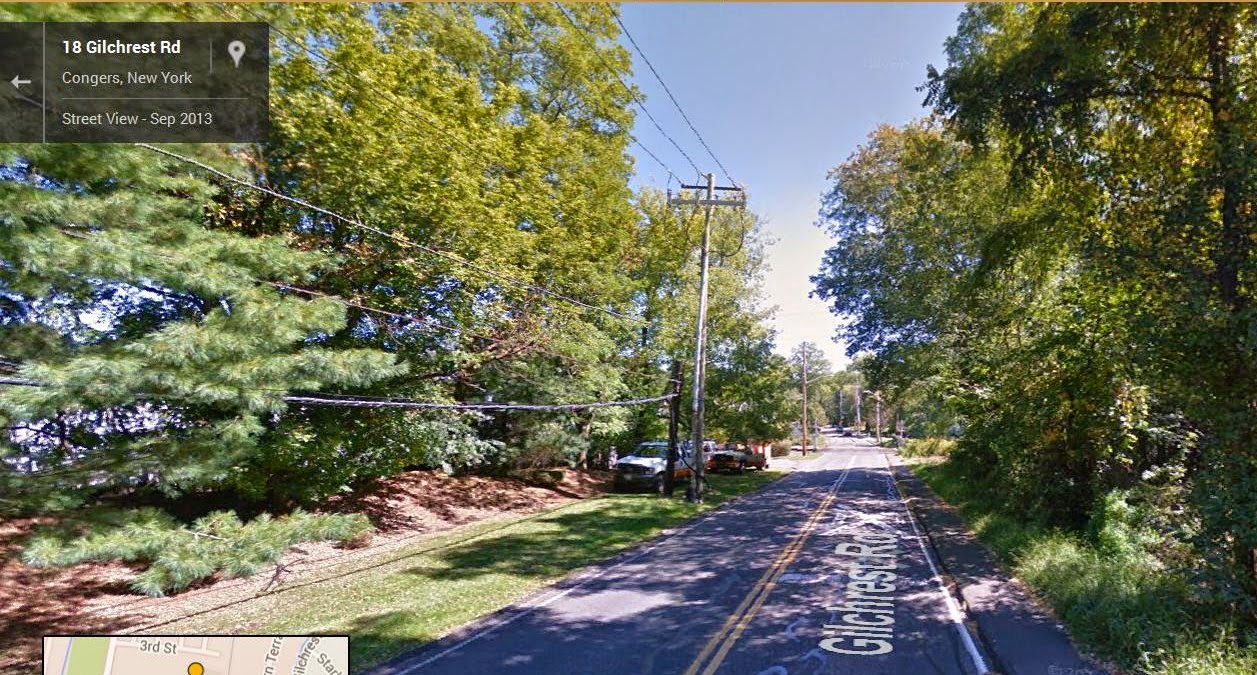 |
| Approaching the Gilchrest Rd crossing from the west, today. This pic was taken during the summer or early fall of 2013...forty-one years and change after the accident, so the view could have changed some, with more growth to the right. Keep in mind, too, that the accident happened in late March, and the trees were still leafless. Several sources noted that the kids could see the train through the trees. Image Courtesy Google Maps Street View |
 |
| Eastbound Gilchrest Rd, approaching the crossing, today. Back in '72 there were no gates or warning signals. Image Courtesy Google Maps Street View |
 |
| Sight line, looking south from the crossing, sitting at the stop line. If the view was anything similar to this back 43 years ago, Joe Larkin had no problem seeing the train. Image Courtesy of Google Maps Street View |
On top of that both
school district policy and...most importantly...state law mandated
that he stop at the crossing. He obviously knew about both the law
and the policy, and tried to deflect responsibility by claiming that
he had indeed stopped. He ignored both the kids and the law because
he was desperate to make it to work on time.
Now, he obviously didn't intend for the bus to get hit, and I think that he truly thought he could beat the train, but I also have a feeling he was fooled by a well documented optical illusion, and a simple one at that. Basically, the larger a moving object is is, the slower it's apparent speed is. The closer you get to it, and the sharper the angle between you and it, the faster it's apparent speed appears to be. Once you're dead in front of it and a couple of hundred feet away...and all you're seeing is, in this instance, the front of the locomotive...it appears to be moving at exactly the speed it's actually going (And, truth be known, probably faster). But by then it's too late.
When Joe Larking first saw it, the train was a couple of hundred yards away, and not going but 25 miles per hour to begin with, so it appeared, in his mind, to be barely moving. At that point he probably did indeed believe he had time to get across the tracks before the train reached the crossing. Tragically, of course he was wrong, and whether he admitted it or not, he ultimately realized it...just too late. He got down on the brakes as he was entering the crossing...almost in front of the train, and well less than 200 feet away. I have a feeling the image of the Penn Central logo bearing down on them stayed with him to the grave. And I hate to put it this way, but I agree with the judge who sentenced him to five years of probation...it should have.
Now, he obviously didn't intend for the bus to get hit, and I think that he truly thought he could beat the train, but I also have a feeling he was fooled by a well documented optical illusion, and a simple one at that. Basically, the larger a moving object is is, the slower it's apparent speed is. The closer you get to it, and the sharper the angle between you and it, the faster it's apparent speed appears to be. Once you're dead in front of it and a couple of hundred feet away...and all you're seeing is, in this instance, the front of the locomotive...it appears to be moving at exactly the speed it's actually going (And, truth be known, probably faster). But by then it's too late.
When Joe Larking first saw it, the train was a couple of hundred yards away, and not going but 25 miles per hour to begin with, so it appeared, in his mind, to be barely moving. At that point he probably did indeed believe he had time to get across the tracks before the train reached the crossing. Tragically, of course he was wrong, and whether he admitted it or not, he ultimately realized it...just too late. He got down on the brakes as he was entering the crossing...almost in front of the train, and well less than 200 feet away. I have a feeling the image of the Penn Central logo bearing down on them stayed with him to the grave. And I hate to put it this way, but I agree with the judge who sentenced him to five years of probation...it should have.
I'll be the first to
admit that I'm extremely judgmental when it comes to
incidents such as this...it's just too easy not to put a
vehicle in front of an oncoming train. And the reason that school
buses get hit by trains pretty much begins to sound like a broken
record. The driver, for what ever actual reason and stated
reason (The two pretty often diverge greatly) placed the bus in front
of the train.
Whoa, Rob, I hear
people saying...you took up for the bus driver in Evans. Indeed I
did, because that was a different situation, and I still cast the
blame on him...there were just mitigating circumstances out the
ying-yang. Here there was only one conceivably mitigation
circumstance...no lights, bells, or gates...and that doesn't
cut it because Larkin was still supposed to stop. And look.
And listen. And, as happened far too often, he didn't.
Of course, the fact
that the bus (Like the great majority of school buses back then) was basically cobbled
together out of separate steel panels with nothing more than a
rudimentary frame, whose primary function was to make the body hold
it's shape rather than add strength, supporting them, doesn't help.
Of course, there are also interior panels, but they, too, were separate panels and weren't meant to be structural...they came
apart even easier then the exterior body panels, leaving multiple sharp, jagged edges. The kids were bounced around the bus like the bean in a baby's rattle in the collision, throwing them against these jagged edges and causing even more injuries on top of the blunt force trauma they were likely already suffering from.
Not only did the body come apart like a dropped eggshell, leaving jagged edges that caused nasty injuries to anyone thrown against them, the seats tore loose and became missiles. Several injuries...severe injuries...were related to this. The two kids who went through the floor and into the path of the train died instantly, but I have a horrible feeling that they weren't the only kids who got hit by the train after they were ejected. .There were a couple of amputations that I have a feeling may have been caused when the patient fell onto the track with an arm or leg across the rail and was hit by the train. Thoughts of the horror of being one of those kids makes me literally shudder. If the bus had stayed in one piece, the outcome, while still bad, would not have been as severe simply because most if not all of the kids who were ejected would have stayed with the bus. Those at the front or rear of the bus would have had a wild ride, but the injuries would have been far less severe.
Not only did the body come apart like a dropped eggshell, leaving jagged edges that caused nasty injuries to anyone thrown against them, the seats tore loose and became missiles. Several injuries...severe injuries...were related to this. The two kids who went through the floor and into the path of the train died instantly, but I have a horrible feeling that they weren't the only kids who got hit by the train after they were ejected. .There were a couple of amputations that I have a feeling may have been caused when the patient fell onto the track with an arm or leg across the rail and was hit by the train. Thoughts of the horror of being one of those kids makes me literally shudder. If the bus had stayed in one piece, the outcome, while still bad, would not have been as severe simply because most if not all of the kids who were ejected would have stayed with the bus. Those at the front or rear of the bus would have had a wild ride, but the injuries would have been far less severe.
Trust me, this fact
wasn't lost on anyone. There had been a good bit of discussion about
a perceived lack of structural integrity in school bus construction
for years, but it had gone no further than being just
that...discussion. But after the Congers bus crash, the lack of structural integrity wasn't
just perceived...it was a given. Bus 596 came apart like a shoe box
after an M-80 exploded inside of it, a fact that the pictures of the
front section of the bus wrapped around the nose of the locomotive
made gruesomely clear.
The crash hit the National news hard and graphic, with both still photos and video of the scene shown on the nightly news...If I'm not mistaken, there was footage of the front end loader lifting the bus off of the locomotive...and for once the talking heads and anchors didn't need to sensationalize the story. All anyone needed to know was plastered across TV screens in living color.
The crash hit the National news hard and graphic, with both still photos and video of the scene shown on the nightly news...If I'm not mistaken, there was footage of the front end loader lifting the bus off of the locomotive...and for once the talking heads and anchors didn't need to sensationalize the story. All anyone needed to know was plastered across TV screens in living color.
The accident had
several immediate effects in New York State, one of them being a
complete overhaul of laws as they related to school bus construction. Within a couple of years, New York State had the most stringent school bus safety standards in the nation. Then the Federal government caught the hint, and passed Federally mandated bus construction standards.This didn't didn't happen instantly, and in fact took about five years, but by 1977 the US Department of Transportation had developed and implemented new construction and safety standards for school buses. After that date, newly constructed school buses
were required to have full framed bodies with one piece inner and
outer side panels, robust anti-intrusion side beams to guard against intrusion in broadside collisions, fuel tanks located inside of and protected by the vehicle's frame rails, multiple emergency exits, padded, high-backed
seats, and in New York State, seat belts.
The accident also got every state in the Union to looking at it's training standards for bus drivers. Today every state in the Union requires a Chauffeurs License or CDL with a special endorsement for school buses, and all states also require drivers to take and pass an extensive course on school bus safety, driving skills and regulations.Again, requirements for school bus drivers are now Federally mandated, making them standard across the board.
So when kids climb
aboard today's version of the 'Yellow Monsters', which are virtual
limos compared to Bus 596 (And every other 60s and early 70s vintage
bus) they can thank the kids who were on Bus 596 that morning in
Congers. It was that accident that started the move to safer buses, with better trained drivers. The sad...and unfortunately, not even vaguely rare...thing, of course, is that it took a tragedy to get us there..
Sadder still, this would be far from the last time that a school bus driver put his or her bus...and the kids riding it...in front of a train.
<***>Notes,
Links, and Stuff<***>
The other posts in this series
in the order they were posted.
December 1961
August 1955
October 1971
August 1976
http://disasteroushistory.blogspot.com/2015/02/fox-river-grove-illinois-bustrain-crash.htm Fox River Grove Illinois October 1995
http://disasteroushistory.blogspot.com/2015/02/conasauga-tennesee-bustrain-crash.html Conasauga Tenn. March 2000
http://disasteroushistory.blogspot.com/2016/03/sandy-utah-bus-train-crashthe-worst.html Sandy, Utah Dec 1938
http://disasteroushistory.blogspot.com/2016/03/proberta-california-train-bus-crash.html Proberta, California Nov 1921
http://disasteroushistory.blogspot.com/2016/02/shreve-ohio-and-berea-ohio-school.html Shreve and Berea Ohio Jan. 1930
http://disasteroushistory.blogspot.com/2016/03/crescent-city-florida-trainschool-bus.html Crescent City, Florida December 1933
http://disasteroushistory.blogspot.com/2016/03/rockville-md-train-bus-crash-april-11th.html Rockville, Maryland April 1935
http://disasteroushistory.blogspot.com/2016/03/mason-city-iowa-bus-train-crash.html MAson City, Iowa Oct. 1937
http://disasteroushistory.blogspot.com/2016/03/eads-tennessee-trainschool-bus-crash.html Eads, Tennessee Oct. 1941
http://disasteroushistory.blogspot.com/2016/03/sandy-utah-bus-train-crashthe-worst.html Sandy, Utah Dec 1938
http://disasteroushistory.blogspot.com/2016/03/proberta-california-train-bus-crash.html Proberta, California Nov 1921
http://disasteroushistory.blogspot.com/2016/02/shreve-ohio-and-berea-ohio-school.html Shreve and Berea Ohio Jan. 1930
http://disasteroushistory.blogspot.com/2016/03/crescent-city-florida-trainschool-bus.html Crescent City, Florida December 1933
http://disasteroushistory.blogspot.com/2016/03/rockville-md-train-bus-crash-april-11th.html Rockville, Maryland April 1935
http://disasteroushistory.blogspot.com/2016/03/mason-city-iowa-bus-train-crash.html MAson City, Iowa Oct. 1937
http://disasteroushistory.blogspot.com/2016/03/eads-tennessee-trainschool-bus-crash.html Eads, Tennessee Oct. 1941
<***>
This post is another
one that I got lucky on, information-wise. There are numerous
articles on line about the accident, including a Readers Digest
article that I recall reading years ago. The NTSB report was
available (And, invariably, refuted some of the information available
in the other articles). I actually had to sort through the
information I had, compare it with the NTSB report, and decide what
to use...a luxury that I didn't enjoy with all, or even most of the posts in
this series (And that I have a feeling I won't enjoy with many of the
posts in the next series of posts, a few months down the road, when
I'll be posting about earlier school bus/train crashes.)
I'd be remiss if I
didn't thank the people and organizations that helped make this post more than a paragraph or two long.
First, a huge thanks
to Jason DiSalvo, Congers FD's 1st Assistant Chief, for
giving me permission to use his department's pictures of the
accident.
Google Maps makes
any of these post far easier and more enjoyable to put together.
Being able to grab a map and/or satellite image makes illustrating
the area of any incident a snap. Of course I could try to draw a
map...but no one would want to have to try to decipher anything I'd
try to draw...trust me on this. The Street View, when available,
makes illustrating the scene of an incident...at least as it appears
today...as easy as making a couple of mouse clicks.
<***>
The
same stretch of track the Congers bus crash occurred on was also the
site of the very first recorded collision
between a train and a school district owned vehicle used to transport
students. The incident happened on a cold, snowy evening in February
1902, when a horse drawn 'Kid Hack' returning kids from a basketball
game was struck broadside by a train after it somehow
got caught between manual crossing gates at a crossing on what's now
West Nyack Rd...also known as Old Route 59...,in West Nyack. The
hack...being made of wood...came apart explosively when
the train slammed into it, killing eight kids...three more than the far
better known Gilchrest Rd crash seventy years later...instantly. Two of
the kids who were killed in the accident were sisters.
<***>
Three months after the accident a memorial was unveiled and dedicated to the five Nyack High School students who died in the accident. The memorial is located in front of old Nyack High School.
 |
| The Memorial |
 |
| A close-up of the plaque, with the names of the five students who died inscribed on it. |
<***>
 |
| Wayne Lifeguard Brochure |
 |
| Early Wayne Lifeguard brochure page illustrating one piece side and roof panels and full frame. |
<***>
While the Congers crash taught lots of new lessons, and reinforced an equal number of old ones, those lessons weren't always heeded...heck they were flat out ignored on a couple of occasions. Case in point:
On October 23, 1974...two and a half years after the Congers crash...an eerily similar and even deadlier bus-train collision occurred in Aragon, Georgia. Like the Congers crash, it was occurred in the morning at an unsignaled crossing that the bus normally didn't cross...and again, like the Congers crash, the reason it was using this crossing was because it had been rerouted that morning because of a detour.
Ironically, the detour was because of a derailment that had blocked the crossing they usually used. The train that hit the bus was a work train that was backing slowly up the track, away from the derailment. The bus driver, seeing the slow moving train, very likely fell into the same trap that Joe Larkin probably fell into...he thought it was moving even slower than it was, and figured he could make it across before the train got to the crossing.
The caboose of the work train hit the bus just about broadside, and started pushing it...the bus' tires 'tripped' about thirty or so feet beyond the crossing, flipping the bus over, and causing the caboose to over-ride it as it rolled onto it's top, ending up with the rear ten feet or so of the caboose on top of the bus, and the center of the bus roof crushed down beyond the seat backs. While the caboose had a radio, it was located inside the cabin (I'm assuming beneath the copula that was an iconic feature of cabooses when they were still used on trains) and the brakeman didn't have a handheld radio...by the time he saw the bus, ran back to the radio, and called the crew in the locomotive, they had hit the bus. Even as slow as it was moving, it took the train just over 300 feet to get stopped after the brakeman, in the caboose, made that frantic radio call to the locomotive. It's believed, by the way, that if the brakeman had had a handheld, and been able to call the locomotive crew as soon as he saw the bus and realized it wasn't going to stop, they would have either gotten stopped, or slowed to the point that the bus could have made it across.
Of course, the brakeman wasn't supposed to be on the caboose...he was supposed to be flagging the crossing, because the train was backing. Had he been where he was supposed to be, he would have flagged the bus to a stop., then climbed back aboard the caboose as it rolled past (Yes...the train was moving that slowly). This still doesn't come anywhere close to absolving the school bus driver of blame...he saw the train and tried to beat it, just like Joe Larkin (And just like Joe Larkin's passengers, the kids on the bus tried to warn their driver that he wasn't going to make it.)
 |
| Scene of the Aragon, Ga crash, with the caboose on top of the bus. |
The bus had 82 kids on board...many of them standing...and seven were killed, while everyone else aboard received injuries ranging from cuts and bruises to critical injuries. Due to the slow speed of the collision, the rollover wasn't all that violent, and no kids were ejected. In fact all of the injuries, from what little info I could find, occurred after the rollover. From the couple of pictures I saw of the accident, the bus body seems to have actually held up fairly well considering it had a train on top of it, making me wonder if it was one of the Wayne Lifeguard bodies I mentioned above.
Strangely, I could find almost nothing on this one...the narrative summary of the accident from the NTSB report (But not the full text), a few archived news articles, and an ancient website created by one of the survivors of the accident and not updated since 2001 were all I could find. (And this is also why this ended up being a note rather than a full post)
<***>
It's a given that
the new safety standards have saved more than a few lives over the
last couple of decades, but I can vouch for two specifically...both
of 'em right here in my home state of Virginia, and both within a
half hour or so driving distance of a town I called home.
The first was in
Petersburg, though I don't remember the date right off hand. A PFD
fire rig broadsided a school bus at one of the city's major
intersections due to a traffic signal malfunction. This was a slow
speed collision, so there was minimal intrusion into the bus, and
injuries were minor. It ended up being a 30 second story on the Six O'clock and Eleven O'clock news that evening and a small, two inch
filler article in the next morning's paper. The traffic signal was
fixed and investigations and meetings were held, the reports of same
were finalized and put on record, a few policies were modified (Both
School Board and PFD, likely), and everyone breathed a prayer that a
few bruises were all that resulted from the accident.
Had the bus been an
older, pre-DOT standards bus the outcome could have been different,
as the front end of the rig...a big Ford chassied 'service truck' (A
ladder company rig that carries all of the ground ladders and tools
of a truck company but no aerial ladder), would have likely caused
the body panels to separate at the point of impact, intruding into
the passenger compartment and throwing some students against the
sharp edges of the panels, causing moderate to severe injuries to at
least the students sitting at the point of impact.
This one wasn't the
biggie, though...the Virginia accident that really proved the validity of
the new safety standards happened just west of Carrsville, Virginia...a
few miles east of Franklin and about 30 miles from my home town of
Boykins...on April 12th, 1984, seven years after the DOT
standards went into effect.
At
about 3:25 in the afternoon on that date, the driver of an Isle of
Wight County, Va school bus pulled into a lane off of State Route 615, hard by the Chesapeake and Ohio tracks, dropped off kids at several stops, than
backed 900 feet or so to an intersecting lane and backed into it to turn around. She then shifted
gears, swung the bus south on 615, and crossed the tracks without stopping,
something she had done, according to witnesses, regularly.
This time, however, a C&O freight was west bound and close, running at the speed limit of 49 MPH for that stretch of track. The driver...already on the crossing...saw the train, stopped the bus with the front wheels on the crossing, and possibly tried to get the bus into reverse and back up. Unfortunately she stalled the bus, and the freight...sliding by then, steel screaming against steel, it's brakes locked in full emergency...slammed into the right front of the bus.
This time, however, a C&O freight was west bound and close, running at the speed limit of 49 MPH for that stretch of track. The driver...already on the crossing...saw the train, stopped the bus with the front wheels on the crossing, and possibly tried to get the bus into reverse and back up. Unfortunately she stalled the bus, and the freight...sliding by then, steel screaming against steel, it's brakes locked in full emergency...slammed into the right front of the bus.
The
entire body of the bus separated from the chassis, spun 180 degrees,
and rolled, landing on it's left side about 85 feet from the
crossing. There were twenty-six kids on the bus when it got hit, and this time all stayed with the bus body as it spun and rolled...one of them was critically
injured, two more seriously injured, and the rest suffered minor injuries
of the cuts-bumps-and bruises variety. Most of the kids
scrambled out through the hole where the front of the bus used to be,
and all of them would recover from their injuries. The driver
suffered critical injuries, and, sadly, died five days after the
accident.
The bus body, pretty well mangled at the front end, stayed in one piece through the collision, spin, and resulting roll-over, and this was a huge factor in the survivability of the accident. Thanks to the new safety standards, and the more robust construction of newer bus bodies, most of the kids just went for a wild and terrifying ride, though several of them were traumatized to the point of not wanting to ride the bus (And several parents wouldn't even allow their kids to ride the bus) afterward. Of course there were other bits of luck involved. The bus was at least a quarter way through it's run, so a good number of the kids had gotten off (Several got off at the stops the bus made just before the collision). Also, a quick review of school bus etiquette...the bus usually fills up from back to front, so many of the kids were sitting towards the rear of the bus when the collision occurred and the train hit the extreme front end of the bus, just about at the joint between the bus body and the cowl...had it hit broadside or at the rear of the bus, where kids would have been sitting at the point of impact, the injuries would have very likely been far worse and there would have very possibly been fatalities.
<***>
Though the efforts to do so were a good deal more low key that the push for better and safer buses, the Congers crash also instigated a push for more uniform training standards for school bus drivers. At about the same time the new safety standards went into effect, new federally mandated training standards were also enacted, This is why now all states require a CDL or Chauffeur's license with the proper endorsements, and the training curriculum...both classroom and behind-the-wheel...is a pretty rigorous and in depth course, and is pretty uniform from Virginia to New York to Texas to California.
<***>
In 1978 Stephanie Zimbalist starred in Long Journey Back, which was a movie based on the life of Mary Jane LiPuma, whose leg was amputated in the accident. Names and events were changed in the movie. On a whim, I plugged the title into Google, and one of the very first links was the YouTube link to the entire movie, posted below.
http://www.imdb.com/title/tt0077866/?ref_=nm_flmg_act_55 Long Journey Back's IMDB page
<***>Links<***>
I went back through all the links I used for research...and there were a slew of 'em...and tried to pick out the best several to include with this post. A couple of them are PDF Files, which means you'll need Adobe Reader or an equivalent PDF reader to view them. The good part with a PDF file is you can download it.
http://www.ratsa.org/Downloads/Congers%203-24-72.pdf NTSB Report from the accident...as alol of these are, it is an extremely informative and interesting read.. This is a PDF File, so you'll need Adobe Reader.
https://www.ptsi.org/
http://archive.lohud.com/article/20120324/NEWS03/303240063/40-years-like-1-day-survivors-Rockland-train-school-bus-crash-killed-5-rewrote-safety-laws A very in-depth newspaper article written on the 40th anniversary of the bus crash.
https://athomeinnyack.wordpress.com/2011/03/24/39-years-ago-today-nyack-high-schools-darkest-day/ Another blog post on the crash, written and posted on the accident's 40th anniversary.
.http://www.waynepost.com/article/20140629/News/140629696 An in-depth article on the evolution of school bus safety
http://www.ntsb.gov/investigations/AccidentReports/Reports/HAR8502.pdf NTSB Report from the Carrsille, Va bus/train crash mentioned above. It goes into far more detail than I had room for in this post, and illustrates just how much of a difference the new DoT safety standards can make. This is another PDF file.
https://www.ptsi.org/
http://archive.lohud.com/article/20120324/NEWS03/303240063/40-years-like-1-day-survivors-Rockland-train-school-bus-crash-killed-5-rewrote-safety-laws A very in-depth newspaper article written on the 40th anniversary of the bus crash.
https://athomeinnyack.wordpress.com/2011/03/24/39-years-ago-today-nyack-high-schools-darkest-day/ Another blog post on the crash, written and posted on the accident's 40th anniversary.
.http://www.waynepost.com/article/20140629/News/140629696 An in-depth article on the evolution of school bus safety
http://www.ntsb.gov/investigations/AccidentReports/Reports/HAR8502.pdf NTSB Report from the Carrsille, Va bus/train crash mentioned above. It goes into far more detail than I had room for in this post, and illustrates just how much of a difference the new DoT safety standards can make. This is another PDF file.


