The
Steamboats Washington,
Enterprise, and
Constitution
Man's
first Lessons on the dangers of modern transportation.
Ahhh, riverboats!! The throaty, bass wail of a multi-toned steam whistle as paddle-wheels thrash the muddy waters of The Mississippi...or Ohio, or Red, or Missouri, or any of a couple of dozen or so navigable rivers...into dirty white foam as wood smoke boils from those classic tall twin stacks and the river pilot holds court in that classic boxy pilot house, feeling the river's mood through the spokes of a gigantic ship's wheel.. It's a scene that's been a staple of just about every movie about the Antebellum South that's ever been made. Heck, there was even a TV series about one
But in all seriousness, these lovely ladies of the western rivers opened up the American west long before there was anything even vaguely resembling an actual intercity or interstate road in that end of the world, giving America it's first taste of reliable, high speed (For that era) long distance travel. They transported tens of thousands of passengers and hundreds of thousand of tons of freight on America's western rivers...but unfortunately, they didn't do so without incident, drama, and...well, a disaster or two or three. Steam propulsion was, after all, a brand new technology in the early 19th century, and what brand new technology hasn't had teething problems before it got on it's feet good..
But...before we get to said disasters, I've gotta kick this one off with a short...very short...basic history lesson RE: Steamboats and the expansion of America, because if we're gonna jump back two or so centuries to talk about the very first major accidents involving the very first steamboats to travel the very first interstate transportation network in the U.S., we kinda gotta talk a little about the development of said steamboats, and the guys who developed them.
But in all seriousness, these lovely ladies of the western rivers opened up the American west long before there was anything even vaguely resembling an actual intercity or interstate road in that end of the world, giving America it's first taste of reliable, high speed (For that era) long distance travel. They transported tens of thousands of passengers and hundreds of thousand of tons of freight on America's western rivers...but unfortunately, they didn't do so without incident, drama, and...well, a disaster or two or three. Steam propulsion was, after all, a brand new technology in the early 19th century, and what brand new technology hasn't had teething problems before it got on it's feet good..
But...before we get to said disasters, I've gotta kick this one off with a short...very short...basic history lesson RE: Steamboats and the expansion of America, because if we're gonna jump back two or so centuries to talk about the very first major accidents involving the very first steamboats to travel the very first interstate transportation network in the U.S., we kinda gotta talk a little about the development of said steamboats, and the guys who developed them.
SO, then!!! Quit talking and shooting spit-balls, eyes front and pay attention! (Rob raps chalkboard with pointer.) History class is in session!!
The US began it's first
big expansion right after The Revolutionary War, with the creation of
The Mississippi Territory in 1798, and the acquisition of the Louisiana Purchase in 1803. These two land acquisitions gave the U.S. around 850,000 square miles of new territory...territory, from which I might add, over a dozen states would ultimately be carved. This newly minted chunk of the then-still-so-new-it-shined U.S.A. measured nearly 1000 miles east to west at it's widest point, and extended north to south from the Canadian border to the Gulf of Mexico .
All of this brand new undeveloped, unsettled land kicked off a human stamped of hopeful land-owner wannabes that makes Black Friday at any given Walmart look like Vacation Bible School. In all seriousness, though, these two pieces of real estate just about doubled the size of the U.S. Thing is, as people settled the new area and founded towns and cities, the problems of shipping and travel to these new towns and cities also doubled.
Two centuries ago, there were very few real roads, period, much less interstate roads,...meaning dirt paths that actually crossed state lines...in the already settled and more or less developed area east of the Mississippi. In the newly acquired lands west of Old Man River, roads were all but nonexistent. Travel was S-L-O-W no matter which side of The Mississippi you hailed from.
OK...history lesson, such that it was, over. Now lets get to that travel problem, and how, two hundred years later, it yielded a post in a blog about disasters big and small.
While there weren't many roads in this newly acquired region, this entire area had one big thing...and I mean 'Big' literally...going for it, travel-wise. Pull up a good map of the Louisiana purchase and the Mississippi Territory...preferably one that shows natural features like...oh, i don't know...rivers and streams. You don't even have to look real hard to see that an obscure little stream called The Mississippi River forms the entire eastern boundary of the Louisiana purchase, and, before finally emptying into the Gulf, that same little trickle of water forms the Mississippi Territory's western boundary. The Mississippi is 2320 miles long, and all but the extreme northern-most 400 or so miles of it is navigable. Better still, Old Man River has hundreds of streams emptying into it, among them around two dozen major navigable rivers, extending navigable waters several hundred miles east and west of The Mississippi itself.
The hearty people who ventured West were not even vaguely stupid, and they knew a good thing when they saw one...the good thing in question being the country's first interstate transportation system, already laid out and ready to use. So, when people congregated and decided to build a town, it was almost a given that it would be on the banks of one of these rivers, allowing them ready access to this natural highway system.
 |
| Map of the Louisiana Purchase, with the Mississippi forming almost the entire eastern boundary. Over two dozen navigable rivers flowed into the Mississippi, extending the navigable waters several hundred miles east and west of the Mississippi. |
They had rivers, they had boats...but they still had a problem. Barges could move downstream with the flow of the river, with the crew pushing poles against the river bottom to keep them off of the muddy shallows near the riverbanks, fend off logs and snags that could punch through a wooden hull like it was made of wet cardboard, and generally keep the bow pointed down stream. Pretty good progress could be made down river, but moving a barge load of goods or a passenger packet upstream...against the river's flow...was another thing entirely. Just try 'poling' a good sized cargo barge from that era upstream against the Mississippi's...or any western river's...current and you'll see what I mean. Unless you hailed from another planet, had a big red 'S' embroidered on the front of all of your shirts, and were allergic to Kryptonite, you weren't going to make much speed getting a barge upstream using manpower alone. Oh, given enough manpower, it could be...and indeed, was...done, but walking along the banks would've been faster and probably less tiring.
Of course, a tow path could be built along the bank and mules or horses could tow a barge upstream...but this created other problems. Infrastructure had to be built and maintained, resources bought and hired, and the stream had to be dredged and cleared near the river bank. If you were going to do all of that ya might as well go whole hog and build a canal (And several, in fact, were built).
 |
| An unknown artist knocked out this wood cut of a flatboat on the Ohio River. She was obviously going down stream, with the current here, as the poles are only being used to keep her in the main channel and off of the banks. If they were heading up river, against the currents, the guys lounging around enjoying the sun wouldn't have been so relaxed, and way more tha two poles would have been in use. |
Or you could use sails...but using wind power in the narrow confines of a river while also having to deal with current brought it's own share of problems. Oh it was doable..,and was done regularly on the rivers along the East Coast...but it was not easy.
Happily, the solution for this problem was being worked on even as The Mississippi Territory was being acquired. Actually, the heart of that solution had been around for almost a century, in the form of the steam engine, which was developed in England and had actually been around in one form or the other since the very late 17th century...but they were not the same engines that powered the worlds first steamboats...not even close. Rather than using high pressure steam acting directly on pistons or turbines, these very early engines used the vacuums created by condensing steam to draft water out of mines. See, these very early steam engines were highly specialized...but not highly efficient...pieces of machinery. They were big, ponderous, fuel-sucking, profoundly inefficient water pumps, and were useful for absolutely nothing else.
Then in 1712 a guy named Thomas Newcomen developed a steam engine that boasted the basic layout of the engines that powered just about every side wheeler to ever ply one of America' rivers. The general layout you may note I said. Oh it still operated on the vacuum principle, but Newcomen's vacuum acted on a piston inside a vertical cylinder rather than directly on water. Also, like a huge majority of riverboat steam engines, the piston in Newcomen's design was connected to a reciprocating 'walking beam'. True, the Newcomen engine's walking beam operated a pump rather than the crankshaft for a pair of paddle wheels, but, again, the basic layout was there. It could have, theoretically, turned a crankshaft, which could have turned a paddle wheel, but it would have been useless for it to do so. (1) The engine was huge...nowhere near small or light enough to be fitted with-in the hull of even the largest ships of that era and (2) the engine ran at about 12 strokes per minute, which would also yield about 12 RPM...if it could actually turn a multi-ton paddlewheel. Remember, these were very low pressure (1-3 PSI) engines, whose main purpose was pumping water...about 10 gallons per stroke. (3) The engines operated in a very jerky manner rather than the smooth operation needed to run machinery of any kind, which is why the few time it was tried...running a gristmill for example...it failed.
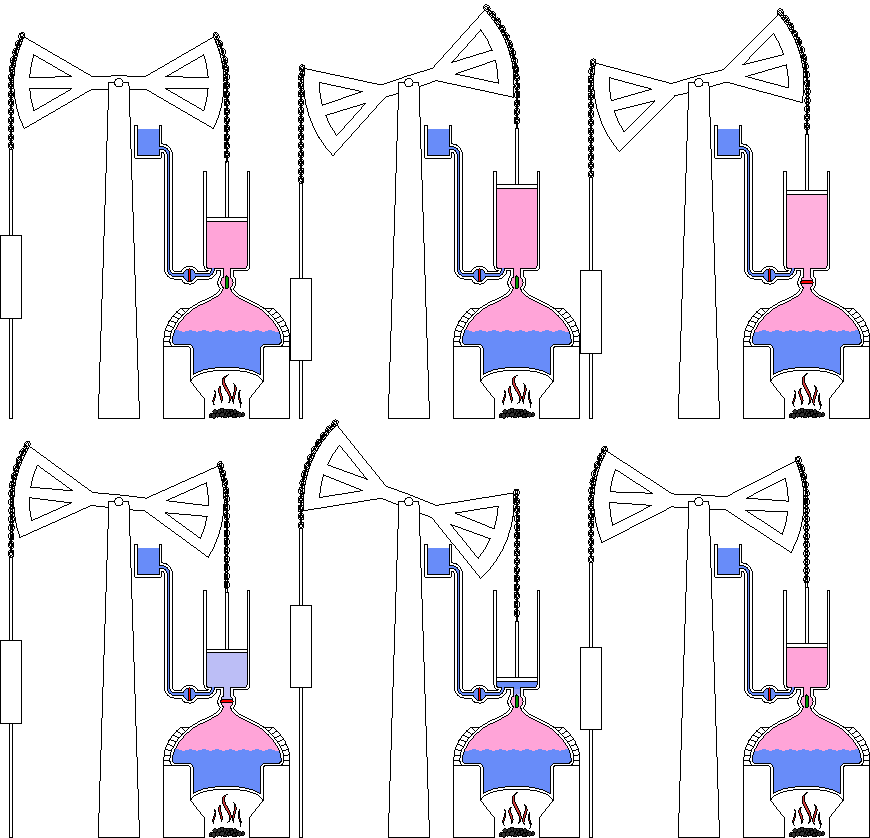 | ||
| A GIF from Emoscopes, showing the Newcomen engine in operation. the pink represents steam, the blue water. Steam pushed the piston upward, then when it reached the top of it's stroke, cold water was sprayed into the cylinder, condensing the steam and creating a partial vacuum. This allowed atmospheric pressure to push the piston down. The 'walking beam' at the top of the image was connected to the piston on one side and the pump on the other side. As the engine piston was pushed downward, it lifted the pump piston, forcing the water out to the tune of about 10 gallons per stroke. |
Newcomen's engine, therefore, was still a slow, cumbersome low pressure engine, suitable only for the job for which it was designed and used, and it would take several decades for steam engines to develop into smaller, faster running, and far more efficient high pressure engines that were small enough, yet powerful enough to propel something like, maybe...a boat..
But, by the late 1700s, work on just such an engine was developing. James Rumsey developed the water tube boiler, and, in 1784, used it on the first successful steam powered boat, which, BTW, was also the first ever jet boat...seriously...the steam engine powered a water pump that blasted a a stream of water out of a nozzle at the vessel's stern, pushing the boat forward. The engine, interestingly enough, was a smaller, somewhat modified version of a Newcomen engine, and it worked because the engine was stacked on top of a piston pump, with the engine piston connected directly to the pump piston. When the engine piston was forced upward by steam pressure, it pulled the pump piston up, which sucked water into the pump...then, when the steam in the cylinder was condensed, atmospheric pressure pushed the engine piston...and the pump piston...down, closing the water intake valve, opening a discharge valve, and forcing the water out of a nozzle beneath the stern.
The jet boat was demonstrated successfully in Shepherdstown, Virginia (Now West Virginia) in December, 1787...the boat was able to make a good three miles per hour against the current. Despite his successful demonstration, Rumsey's design was never developed commercially, though.
 |
| Detailed illustration of how Rumsey's steam powered jet boat worked. |
The jet boat was demonstrated successfully in Shepherdstown, Virginia (Now West Virginia) in December, 1787...the boat was able to make a good three miles per hour against the current. Despite his successful demonstration, Rumsey's design was never developed commercially, though.
James Watt had developed the separate condenser a few years before Rumsey launched his steamboat, and Rumsey gladly adapted the separate condenser to his own engine, The separate condenser allowed the cylinder to stay at the same temperature at all times, which increased the efficiency of atmospheric (Vacuum ) engines two to three fold because energy wasn't wasted reheating the cylinder on each stroke.
Watt then teamed up with Matthew Boulton to develop the double acting steam engine, with high pressure steam actually acting directly on both sides of the piston, as well as developing a way to convert the piston and connecting rod's straight line motion to rotational motion, allowing it to turn a shaft...and an engine that could power a steamboat was born.
Watt then teamed up with Matthew Boulton to develop the double acting steam engine, with high pressure steam actually acting directly on both sides of the piston, as well as developing a way to convert the piston and connecting rod's straight line motion to rotational motion, allowing it to turn a shaft...and an engine that could power a steamboat was born.
John Fitch gets credit for the first steam boat in actual commercial service. His first design...a strange contraption that utilized (I'm not making this up) steam-powered oars was less than successful, and was never demonstrated successfully, but his second design replaced the side mounted oars with stern mounted reciprocating paddles, mounted on a chain driven crankshaft, that drove the boat upstream at about three knots. Fitch made some improvements and built second and third boats that were larger (About 60 feet long), faster (Around seven or eight miles per hour) and became the first commercial steam boats, running between Philadelphia and Wilmington, Delaware three times a week during the summer of 1790.
A guy named Mike Sheppard built a working model of John Fitch's first steam boat...the one propelled by
steam powered oars. This model's powered by an electric motor, but from listening to his comments on the
video, he's planning on swapping it out for a steam engine. Apparently this model is way more successful
the actual steamboat was.
steam powered oars. This model's powered by an electric motor, but from listening to his comments on the
video, he's planning on swapping it out for a steam engine. Apparently this model is way more successful
the actual steamboat was.
A working model of John Fitch's second steamboat, which went in service on the Delaware River in 1890,
to become the first steamboat in commercial service in the US.
The John Fitch Steamboat Museum, in Bucks County, Pa, built this awesome, six foot long working model,
which is actually powered by an electric motor rather than a steam engine. As Rube Goldbergish as those stern paddles seem to be, Fitch's steamboat was actually pretty advanced for her time. She was also four miles per hour faster than Bob
Fulton's North River, which plied the Hudson River seventeen years later. The rudder on the model is actually
a more modern set-up than that on the actual steamboat...the model is, after all, radio controlled. Fitch's steamboat
was still steered with a tiller, with the helmsman standing at the stern, exposed to all that spinning, chain-slapping, thrashing machinery.
Another video of the Fitch Steamboat Museum's model, showing the operation of the engine and paddle
mechanism in closer and better detail. You can also see how big the model actually is.
Unfortunately, the boat had a pretty limited passenger capacity, very few people took advantage of the service in the first place, and the fuel-hungry boiler burned wood like it was going out of style. Lesson One was learned about commercial steamboat (And self propelled vehicle in general) operations...you have to make enough money through passengers and freight revenue to off set fuel costs, and your engines have to be fuel efficient so said fuel costs won't be too high. The nation's first steamboat service folded after only three or so months.
to become the first steamboat in commercial service in the US.
The John Fitch Steamboat Museum, in Bucks County, Pa, built this awesome, six foot long working model,
which is actually powered by an electric motor rather than a steam engine. As Rube Goldbergish as those stern paddles seem to be, Fitch's steamboat was actually pretty advanced for her time. She was also four miles per hour faster than Bob
Fulton's North River, which plied the Hudson River seventeen years later. The rudder on the model is actually
a more modern set-up than that on the actual steamboat...the model is, after all, radio controlled. Fitch's steamboat
was still steered with a tiller, with the helmsman standing at the stern, exposed to all that spinning, chain-slapping, thrashing machinery.
Another video of the Fitch Steamboat Museum's model, showing the operation of the engine and paddle
mechanism in closer and better detail. You can also see how big the model actually is.
Unfortunately, the boat had a pretty limited passenger capacity, very few people took advantage of the service in the first place, and the fuel-hungry boiler burned wood like it was going out of style. Lesson One was learned about commercial steamboat (And self propelled vehicle in general) operations...you have to make enough money through passengers and freight revenue to off set fuel costs, and your engines have to be fuel efficient so said fuel costs won't be too high. The nation's first steamboat service folded after only three or so months.
Then, nearly two decades later, in 1807, we have the guy who all of our history books told us invented the steam boat...Robert Fulton. Bob Fulton didn't invent the steam boat. He just made it commercially viable. His North River Steam Boat...later shortened to North River, and, due to an error by a 19th century historian, known to millions of school kids and amateur historians today as the Clermont... was big and fast enough to be a success and was also the first to employ that iconic symbol of the Steamboat Era, the paddle wheel. She was 150 feet long, had a beam of 18 feet, drew about 3 feet, and displaced just over 120 tons. That long slender hull could knife through the water rather than shoving it aside, so with her 15 foot diameter side wheels thrashing the Hudson River's waters, she could make a then astonishing 4 or 5 MPH.
 |
| A replica of Fulton's North River...Better known as the Clermont...built for the Hudson-Fulton celebration. The replica was 150 feet long with a beam of 16 feet, and powered by a reproduction of the James Watts style engine that powered the original.. The replica was a faithful as possible, working from old sketches and paintings and was around until the mid 1930s, when she was broken up for scrap. One thing they did get wrong, though...as she was never actually named Clermont, she never had that named painted on her bow. |
She had decent speed and comfortable passenger accommodations that included berths for 56 passengers, a bar, and a kitchen, which reportedly even served pretty good meals. Most importantly, she could make the run from New York City to Albany in 32 hours versus the four days it took by sailing ship.
As if that wasn't good enough, two years later Fulton, along with his business partner Robert Livingston, put the first steamboat on Western waters in service on the Mississippi River. Slightly larger than Clermont, New Orleans was also successful, and was the first of thousands of steamboats that would ply the western rivers of the U.S. Her first voyage, captained by another of Fulton's business partners named Nicholas Roosevelt, took her from Pittsburgh to New Orleans, via the Ohio and Mississippi rivers...She departed from Pittsburgh on October 15th, 1811 and reached New Orleans five days shy of three months later, on Jan. 10th, 1812. Roosevelt returned to New York and ended his affiliation with Fulton shortly afterwards, while Fulton preceded to put the New Orleans in service making regular runs between New Orleans and Natchez, and all was well with the world.
 |
| Robert Fulton's New Orleans passing a flatboat on the Mississippi. New Orleans was a slightly larger clone of the North River, AKA Clermont, and her deep draft was pretty much completely unsuitable for regular service on most of the Western rivers, confining her to the deeper waters of the southernmost section of the river, running between New Orleans and Natchez, Mississippi. |
Actually,...no, it wasn't. Problem was, technology was having trouble keeping up with itself.
'Say what?' You ask. Read On, say I.
As steamboats were built, and developed, and improved, engines were built to operate at higher pressure to provide more speed (Particularly when running against against the current ) and be more efficient, and the boats became bigger and bigger...and boiler technology began to lag behind engine technology.
In fact, boiler technology already lagged behind engine technology, because the great majority of boiler manufacturers had no real clue about the forces involved in converting water to high pressure steam.. Oh, they knew that boiling water equals steam, therefore if they build a fire under this large metal container of water, it'll boil and produce said steam, and they knew how to produce more steam at higher temperatures...and pressures... for more efficient engine operation, but it's what they didn't know that was the problem.
They had absolutely no clue about such factors as the tensile, compressive or shear strengths of
metals, and how those forces were changed as the metal heated. Operating engineers did not know the effects of scaling, mud,
etc. They may not have initially even realized...as basic as this concept is...that if you let the water get too low, then introduce cold water onto super-heated metal you get an instant and catastrophic explosion.
On top of all of that, there were no Government safety standards in place for boilers, or steamboats, or, in fact, any mode of transportation. If someone wanted to build a steamboat out of paper and try powering it with a cardboard boiler, there was no government agency to tell him he couldn't do so, or to point out that his project was doomed to either soggy or fiery failure.
This, of course, means there was no governing standards of material or construction quality for the boilers, the engines, or the steamboats they powered, nor were there standards of competency for the crews of those steamboats. The general public literally believed that the benevolence of business owners would protect them, and that this same benevolence would lead said business owners to do whatever was necessary to keep them safe, no matter what the cost.
Their ignorant bliss can be understood and excused though...remember, until The Richmond Theater Fire of 1811 there had been no man-made disaster in the US (And only a very few world wide) that had caused major loss of life, and multi casualty transportation accidents were all but unheard of. The only vehicles capable of carrying a large (For that era) number of people were ocean going ships, and their loss was generally weather related rather than equipment or human error related. Inland, large passenger capacity vehicles, be they land or water craft, just didn't exist, therefore the general public couldn't comprehend the possibility of a large number of people dying in a single accident.
This was about to change.
By early 1819, there were just shy of 40 steamboats in operation in the United States.Three of 'em...just shy of 8%...had already suffered fatal boiler explosions, and these three explosions occurred within the span of just under a year.. This is the story of those three ill-fated steamboats....The Washington, Enterprise, and Constitution.
Henry Shreve Gets In On The Act
While Fulton's New Orleans was the first steamboat on the Mississippi as well as the first to make a trip encompassing the entire navigable length of the river, she really wasn't well suited to the western rivers. She was basically a larger version of the North River AKA Clermont, with a length of 148 feet, a beam of 32 feet, and, most importantly a 'maximum depth ' of twelve feet. I'm betting that was measured from the main deck to the keel, which would have probably given her a draft of around six feet.
This deep draft caused New Orleans and her intrepid crew some problems on her first voyage, especially at the lower falls of the Mississippi and, once she made it to New Orleans and started commercial service, confined her to the lower Mississippi, which tended to run both wider and deeper than the upper reaches of the river.
Did I mention the fact that, while setting up the first regular steamboat service on the Mississippi, Fulton also snagged himself and business partner Robert Livingston exclusive rights to operate steam boats on the lower Mississippi River? At least he thought he did.
Enter a dude named Henry Shreve.
Shreve was born in 1785 in Mount Pleasant, N.J., then was hauled off to Fayette County, Pa. at the age of three, when his family moved (Their new home was on land owned by one George Washington, BTW). Their new home was also near the Youghiogheny River, where young Henry Shreve most likely watched man and wind powered vessels travel back and forth and, like boys the world over, wondered what it would be like to crew (Or better still, own) one of these boats.
He'd find out at in 1799 at the tender age of 14, when his dad died and he signed on to a barge crew to help support his family. He also very likely...and very quickly...found out that much of the glamour associated with crewing on one of these beasts was imaginary, especially when he was one of the crew members manning the poles when they were poling her against the current.
Did I mention the fact that, while setting up the first regular steamboat service on the Mississippi, Fulton also snagged himself and business partner Robert Livingston exclusive rights to operate steam boats on the lower Mississippi River? At least he thought he did.
Enter a dude named Henry Shreve.
Shreve was born in 1785 in Mount Pleasant, N.J., then was hauled off to Fayette County, Pa. at the age of three, when his family moved (Their new home was on land owned by one George Washington, BTW). Their new home was also near the Youghiogheny River, where young Henry Shreve most likely watched man and wind powered vessels travel back and forth and, like boys the world over, wondered what it would be like to crew (Or better still, own) one of these boats.
He'd find out at in 1799 at the tender age of 14, when his dad died and he signed on to a barge crew to help support his family. He also very likely...and very quickly...found out that much of the glamour associated with crewing on one of these beasts was imaginary, especially when he was one of the crew members manning the poles when they were poling her against the current.
But he was studious, industrious, and tack-sharp smart, and by 1810 he'd bought his own barge. What, or even if he named her, how big she was, and how many men comprised her crew are facts and figures long lost to history, but what is known is her home port was Brownsville, Pa, on the Ohio River, and she made trips as as far south as New Orleans. On that 1814 trip, she arrived in New Orleans on February 11th, loaded, then departed for Brownsville, being poled against the current up the Mississippi and Ohio Rivers to reach Brownsville sometime in July of 1814.
That's right. Six months to make a trip that would take about a week on a modern freighter or tow boat today, and wouldn't have taken much longer, once steamboat service was well established on the Mississippi and other major rivers, in the mid to late 1800s. I have a feeling it was during this six month manual-labor-fest that Henry got the thought 'There's gotta be a better way!' . And, in fact, a group of investors in Brownsville were a couple of steps ahead of him as, while Shreve was on his epic journey to New Orleans and back, they decided to build, designed, commissioned, and began construction of a steamboat, to be named Enterprise.
I'm not going to get too far into the career and voyages of the Steamship Enterprise here other to say she was uber-successful, even becoming the first steamship ever to be used by the military in war-time, and that she deserves (And will get) her own post, and that, on that first-ever-mission-by-a-military-steamer, she was captained by none other that Henry Shreve because of his knowledge of the Mississippi River. She also became the first steamboat to make the northbound trip from New Orleans to Pittsburgh, still under command of Henry Shreve.
It was during this voyage that Shreve decided he wanted a steam boat or two of his very own.
The Steamboat Washington's Boiler Explosion
The First Steamboat Accident on America's Western Rivers.
Henry Shreve, along with four partners, designed a new steamboat, and commissioned her construction at a boat yard in Wheeling, Virginia (Now West Virginia...t'was still part of the Old Dominion back then!). A couple of interesting points about the Washington. First, everyone gets her confused with another steamboat named the George Washington, also built and owned by Henry Shreve. The George Washington was said to be the very first 'Classic' Mississippi River steamboat...You know multiple decks, forward pilothouse flanked by tall twin stacks, engines on the main deck, wide, shallow draft hull...problem is, lots of people and publications and web pages think she was the first Washington
Guess what gang...she wasn't. Oh the first Washington still had lots of those classic features, though. The lessons of deep draft vessels on the nation's western rivers had been well learned, so she was one of the first steamboats built with a horizontal main engine that, along with her boilers...four of them... was located on the main deck rather than in the hold. This allowed her to have a broad-beamed, flat-bottomed, shallow draft hull. She was just over 136 feet long with a beam of 22 feet, a displacement of 211 tons, and most importantly, a draft of only three feet. Unlike the classic riverboats, however, she only had a single deck, if the few drawings of her that I could find are accurate. The description I (Finally) found of her describes her main cabin as being 60 feet long, and containing 'Three beautifully appointed private rooms as well as a bar room'. Her main cabin was forward, with her engine and boilers aft. She also had a single smoke stack rather than the tall twin stacks of classic riverboats, but she did apparently have the square, high-mounted pilothouse that was a familiar feature of classic Mississippi Riverboats.
She also boasted another feature that was unique at the time, but which would become commonplace...she was a stern-wheeler, with her paddle-wheel located at her stern rather than having a paddle wheel mounted on either side. Her engine and boilers...both designed by Shreve...were aft, on the main deck. The engine was described as being an extremely simple and lightweight affair, having neither a beam (I'm assuming they mean Walking Beam) or flywheel, and weighing only 9000 pounds ('Lightweight' was obviously relative.).
She also boasted another feature that was unique at the time, but which would become commonplace...she was a stern-wheeler, with her paddle-wheel located at her stern rather than having a paddle wheel mounted on either side. Her engine and boilers...both designed by Shreve...were aft, on the main deck. The engine was described as being an extremely simple and lightweight affair, having neither a beam (I'm assuming they mean Walking Beam) or flywheel, and weighing only 9000 pounds ('Lightweight' was obviously relative.).
She was well appointed, well crewed, and was sort of the space shuttle of her era when she was launched in mid 1816...and she was doomed to become the very first steamboat to be involved in a major accident when, on June 9th, 1816, she also became the first steamboat to suffer a boiler explosion.
She was still apparently in the testing phase at the time, and had no passengers on board when she arrived at Marietta Ohio on June 7th, with Henry Shreve and a well trained crew aboard. The Washington was the third steamboat to go in service on Western waters, making her very much a curiosity, so I have a feeling that she was made available for tours to the public. As she sat wharf-side for a day, the citizens of Marietta and environs there-of trooped to the Ohio River waterfront, crossed the gangplank to board her, and admired her lines and technology, young boys as wide-eyed with wonder as young boys two centuries later would be while touring the Space Shuttle or gazing at the SR-71 Blackbird.
Things get a little muddled as she leaves Marietta...sources note that she left Marietta on the afternoon of the 7th and made it to a town called Harmar, Ohio by the afternoon of the 8th. Problem is, there is no Harmar Ohio today, though there is a historic Harmar Village (As well as the Fort Harmar Historic Site) at the confluence of the Ohio and Muskingum Rivers, both old fort and historic village deeply inside the small city of Marietta today. Not being able to find a modern Harmar Ohio anywhere...and believe me I looked...I'm going to make the assumption that the village located at 'Historic Harmar Village' was indeed their stopping place.
At any rate, on the afternoon of the 8th, she anchored near the Ohio shore, or possibly moored at Harmer's town dock, her black gang banked her fires, and the crew settled in for an evening of rest, relaxation, and whatever else steamboat crews might have done with their down-time in the middle of America's Heartland 200 years ago.
 |
| The confluence of the Ohio and Muskingum Rivers today...smack dab in the middle of the city of Marietta, Ohio today, but back in 1816, Marietta was a tiny village, and the area outlined in red was the approximate location of the village of Harmar. Williamstown didn't yet exist...the then-Virginia side of the river was all woods. The current on the Ohio would have been flowing right to left (West) while the current from the Muskingum would have been pushing south, shoving the disabled Washington towards the Virginia shore. She was probably somewhere between 'Ohio River' and the river bank near present day W 3rd Street when her kedge anchor was deployed...and her boiler exploded. |
At any rate, on the afternoon of the 8th, she anchored near the Ohio shore, or possibly moored at Harmer's town dock, her black gang banked her fires, and the crew settled in for an evening of rest, relaxation, and whatever else steamboat crews might have done with their down-time in the middle of America's Heartland 200 years ago.
What happened the next morning was a true case of being in the wrong place at the wrong time for several members of her crew. Bright and early, her engine room crew lit off her fires and waited for steam pressure to build as the rest of her crew made preparations to head up-river. Shreve was likely eager to get moving, and as soon as his chief engineer informed him they had steam up, he gave the order to cast off. The pilot probably gave a good long blast on the whistle, the lines were cast off, and the Washington eased out into the current. One problem though...they did so before her throttle was opened, therefore she wasn't under power.
The couple of articles about the disaster that I could find simply stated that 'a difficulty occurred in getting the boat into a proper position to start the machinery' without going into any real detail about said difficulty at all, so the reason she was drifting and her stern wheel wasn't thrashing the waters of the Ohio River has been lost to history. What is known, however, is that the current grabbed her and took her towards the Virginia (Now West Virginia) side of the river. Remember, if Harmar was where I think it was, they were right at the confluence of the Ohio and the Muskingum rivers, with the Muskingum dumping into the Ohio...and Washington drifting in the watery mixing bowl formed by the colliding currents of the two rivers. The current was probably turning her even as it aimed her towards any snags that might be luring just below the surface of the water along the Virginia side of the river, waiting to punch a hole in the hull of any out of control watercraft that might drift up onto them.
With thoughts of just how much damage a snag could do to Washington's wooden hull running through their heads, things likely got real busy for her crew at about that point, with lots of purposeful fast motion, engineers accusing recalcitrant machinery of vile and despicable acts, and Shreve judging just what the current of two rivers would do to her and where it would take her without power...where ever the current took them, without power, and therefore out of control, it couldn't be good.
With thoughts of just how much damage a snag could do to Washington's wooden hull running through their heads, things likely got real busy for her crew at about that point, with lots of purposeful fast motion, engineers accusing recalcitrant machinery of vile and despicable acts, and Shreve judging just what the current of two rivers would do to her and where it would take her without power...where ever the current took them, without power, and therefore out of control, it couldn't be good.
Shreve was right on top of it, though, and ordered a kedge anchor set off of the stern, then, after it plopped into the Ohio's muddy waters, he very likely ordered a second one readied in case the first one dragged. After a few minutes that very likely seemed like a few months, the first kedge's flukes dug into the river's muddy bottom, and the Washington jerked to a stop, water eddying around her stern as whichever stern quarter the anchor line was off of (She was a stern wheeler, remember, so the anchor couldn't have been directly off of the stern) dipped, giving her a very slight list.
Now a kedge anchor has a very specific purpose...it's primary use is to reposition a boat by pulling the anchor line in while the anchor is set, and Shreve ordered the entire crew, with the probable exception of the boat's pilot and a couple of men in the open air engine room, to the stern so they could do just that. I think I know what he was trying to do...not only was he trying to pull her back towards the middle of the river, he may have been trying to turn her so her bow was heading in the direction he actually wanted to go before trying to get her moving under her own power.
OK, keep in mind here, the the fire was still burning, which meant that the steam pressure was still building, and with the engine not running, there was absolutely no way...other than the safety valve...to siphon off any of that pressure. And they were completely unaware of one very vital fact...the weight that was used to set the safety valve on one of the boilers had somehow slipped to the far end of the lever that governed the valve's 'pop-off' pressure, 'gagging' it...locking it closed. So, at that point in time that boiler actually didn't have a safety valve...
...Would it surprise anyone to find out that the boiler with the defective safety valve was also the one closest to the anchor windlass?
...Would it surprise anyone to find out that the boiler with the defective safety valve was also the one closest to the anchor windlass?
So ten or twelve men are straining at the anchor windlass. bringing the line in, slowly inching the Washington towards the middle of the river. The river current's singing a rushing, swooshing roar as it eddies around the stern of the boat, some of it splashing up onto the deck and splattering the crew. Shreve's watching the river, gauging the boat's progress, possibly entertaining the thought of having a couple of his crew grab poles in case they were needed to swing the Washington's bow...
The majority of the crew were at the Washington's stern, most of the probably clustered around the anchor windlass, when a sudden rending, crashing 'POP!!" tore the air at the same instant the whole world turned white as all of them were suddenly immersed in a horizontal stream of high pressure, super-heated steam. The separate sheets of iron that formed the near end of the boiler ripped apart at the seams like cloth, turning rivets into bullets and filling the scalding steam-cloud with deadly, fast moving shrapnel.
Several of the crew...including Shreve...were blown overboard, but most remained aboard after getting shredded by flying metal and parbroiled by super-heated steam. The citizens of Harmar had heard the boiler let go and hauled freight to the water front, and several of them, thinking at first that the steamboat was on fire when they saw the roiling clouds of steam boiling off of it, launched boats and pulled hard towards the stricken craft, picking up all but one of the crew members who had been blown overboard while they were at it. One of Washington's crew was carried away by the current after being blown overboard.
The Washington rocked gently mid-stream, the line for the kedge anchor pulled taut, her hull, thanks to the boiler's location on the main deck, undamaged. Steam still rolled from the after portion of the boat, but in quickly decreasing volume, and it was becoming real obvious, real fast that the scene awaiting them on board the damaged steamboat was not going to be a pretty one...they could hear piteous moans and screams of pain while they were still a hundred or so feet from the boat.
When they reached the Washington, they found the steam-seared bodies of several men who, having been right on top of the boiler when it exploded, had been killed instantly. The injuries were literally horrible. Boiler plates had frisbeed through the crew like giant throwing stars, amputating limbs and inflicting truly horrible wounds, while the scalding super-heated steam literally cooked anyone in it's path alive, causing full body, full thickness 2nd and 3rd degree burns that weren't survivable...but left their victims to suffer hours of agony before they finally died. It's reported that one man actually offered another all of his money and worldly goods if he'd put him out of his misery.
The worst injured were gently loaded aboard a couple of the boats and taken to the town's dock, to be cared for by the town's doctor...but there wasn't anything he could do. Face it, during that era people died of things that you wouldn't even call in sick from work for today. Treatment for injuries as severe as those resulting from the explosion wouldn't exist for well over a century. All the doctor and the townspeople could do was make them as comfortable as possible, and offer compassion.
Seven people were apparently killed instantly by the explosion with another five dying later, bringing the death toll in the accident to 12... significant in any era, huge for a transportation accident in 1816. Interestingly enough, even though 17 people were either killed or injured, the Washington herself wasn't destroyed...she wasn't even that badly damaged at all.
With her engine and boilers being located aft on the main deck, it's a good bet that her after deck house was wide open. As the explosion blew the end of the boiler out. the force of the explosion was expended horizontally, the blast force and steam burst rushing aft and possibly over the stern quarters, sparing the boat's upper works. With no solid bulkheads for it to splinter, the rush of high pressure steam dissipated in the muggy summer air pretty quickly, leaving the structure of the boat itself relatively undamaged. Had she been steaming up-river, with most of her crew forward, the explosion would have been a major inconvenience, but injures would have been relatively light.
Her remaining engine room crew probably quickly banked the fires in the furnaces for the other three boilers so they wouldn't explode as well, Then, once all of the dead and injured were removed from her, her remaining crew, along with, very likely, several able bodied men from the village of Harmar, horsed her back to the town dock, probably using the two kedge anchors (pulling her up to the point where the first anchor was set, then tossing the second in the direction they wanted to pull her and making sure it was set before pulling the first one up), and using poles to position her until they could get her close enough to the dock for her mooring lines to be cast, and used to warp her along side the dock. It would have been a long, backbreaking, sweat-popping process, probably taking a day to do what, even fifteen years later, would have only taken a few minutes with another steamboat assisting her.
I'm of course assuming a lot here, the fact that Harmar had a town dock being one of those assumptions, but lets just assume that there was indeed a town dock, and that it indeed where the ill-fated Washington was moored after her boiler exploded. Shreve and his remaining crew probably wasted no time in trying to figure out why they couldn't get the engine on line in the first place, as well as cutting the damaged boiler out of the steam supply line (All ships/steamboats with multiple boilers are designed to run with one or more of them off-line...it would require only the closing of a couple of valves) Once they got her running, and what perfunctory investigations were done were completed, they likely limped her back to Marietta for repairs to her boiler.
Speaking of 'perfunctory investigations', there had to be some kind of investigation because deaths were involved. A coroners jury would have been convened to determine cause of death as well as at least a general idea of why it happened...this is very likely how the malfunctioning safety valve was discovered and reported in the news reports of the accident. Of course, that's not the only effect the media had. While the technology was primitive, and information traveled at a snails pace if it had to go further than the town of origin, the media was, and is, still the media.
Word of the accident spread through-out the area like a wind-driven brush fire, with the story getting a little bit more gruesome with each retelling. Twelve people dying in a single incident is news today...in 1816 it was huge, and had the very real potential to be devastating to the development of steamboat travel. If Washington was the Space Shuttle of her era, then her boiler explosion was her era's Challenger explosion, and had pretty much the same effect on steamboat development and travel on the western rivers...though much more temporarily...that the Challenger explosion had on the Space Program. The general public gave lots of thought to the dangers of steamboat travel, and seemed to be deciding that the possibility of being parbroiled in a burst of super-heated steam or cut down by flying boiler plate just might outweigh the convenience of fast travel.
Washington sat dockside for two or three months, and was probably repaired where she was moored...I'm going to make a bet that her new boiler was also built in place, the ability to transport heavy machinery over land being seriously limited to non-existent back then.
It took Washington's repair and rechristening to breath some more life into development of steamboat travel on Western waters. She was back in service by at least mid-September of 1816, and was logged as arriving in New Orleans on October 7th...one of two runs she made to New Orleans that year.
It was an 1817 trip to New Orleans that she's best known for, however...the 'Fast Trip'. She left Louisville, Ky on a March, 1817 run to New Orleans, and made the trip down-river...with the current...in six days. One of the first vollies in the legal battle between Fulton and Shreve over Fulton's legal monopoly on Riverboat travel on the lower Mississippi was fired while she was in New Orleans, BTW...a battle that Shreve would ultimately win when the courts declared the monopoly illegal, despite the fact that it was the State of Louisiana that granted it.
After this legal fire-fight was over, she departed New Orleans, this time with passengers aboard, for Louisville and made the trip upriver...traveling against the current...in just twenty-five days, tying the existing record set by the Enterprise, with a record 31 days for the round trip.
Washington continued to ply the Ohio and Mississippi Rivers for another seven years or so...she appeared regularly in the warfage books of Louisville, New Orleans, and ports in between until she just dropped out of sight after 1824 or thereabouts, apparently finally worn out. Interestingly enough, she and Henry Shreve's George Washington...the boat she's so often confused with...were very possibly in service at the same time for just a brief period The George Washington was launched and went in service in 1824...the year that the Washington dropped out of sight...so it's not at all unlikely that each of their logs may note them 'Speaking'...greeting an oncoming boat with a whistle blast...the other a couple of times.
The Steamboat Enterprise's Boiler Explodes in Charleston Harbor
September 10, 1816
Washington's boiler explosion wasn't the only fatal steamboat accident during the summer of 1816...that summer was actually book-ended by a pair of steamboat boiler explosions, and the boat that suffered the second one even had a familiar name...Enterprise. But she wasn't the Enterprise that so famously became the first U.S. Military steamboat. She was yet another Enterprise...a name that seems to have become popular as a name for ships both well known and obscure.
If her boiler had exploded on one of the western rivers only three or so months after Washington's boiler exploded, it could've been a major setback for development of river travel by steamboat. But Enterprise's boiler didn't explode on a Western River...it exploded in an eastern harbor. By the time the news of Enterprise's boiler explosion reached the cities and towns along the Mississippi, Washington was back in service and had made a couple of trips without mishap. Also, a couple of other steamboats were plugging away faithfully and so far at least, safely on the Mississippi and other western rivers. By the time Enterprise's boiler exploded, all was forgiven, so to speak, on the Western rivers, and things were just about back to business as usual. So, while Washington's boiler explosion caused, at most, a temporary set-back to steamboat development out west, Enterprise's boiler explosion had little effect at all.
In fact, if it hadn't been for the afore-mentioned boiler explosion, this particular Enterprise would have likely faded into history after several years of of service, which is what happened to the very great majority of steamboats. As it is, all we really know about her is that she shared a name with her far better known contemporary on the Mississippi, and that she suffered the second fatal boiler explosion on a working steamboat. We can make a few assumptions about her though. Being in service on the east coast...and on a harbor rather than a river at that...she was probably a deep draft vessel, much closer in configuration to Fulton's North River than to Shreve's Washington. and we can safely assume that she very likely wasn't a small boat. Oh, she wasn't huge, but she was big enough to have a deck-house that could accommodate at least 70-100 people.
We also know that at about 9 PM on the evening of September 9th, 1816, Charleston, South Carolina was experiencing one of those gully-washer thunderstorms that are pretty much part of everyday life during the summer in the south. Enterprise had just pulled away from her dock on Sullivan's Island, likely located on the east side of the 'L' shaped islands 'hook' (See the map below.). Her just-boarded passengers...all men, from the source I found...wasted no time at all crowding into the deck house to escape the rain thundering onto Enterprise's wooden deck.
Her captain called for all ahead a quarter or so as she eased away from the dock (Through a speaking tube...engine room telegraphs were still a half century or more in the future) and the paddle wheel buckets (She was probably a side wheeler) started splashing into the water of Charleston Harbor as her pilot, captain, and everyone else in her pilothouse peered through the curtain of rain that was hiding anything over 100 yards or so away from view. Sullivan's Island slowly receded astern as her captain and helmsman started working her into the narrow channel that would take her around the tip of the Hook and into Charleston Harbor itself. A few of her braver passengers stayed on deck to...what? Experience the wonders of nature in a full-fledged tantrum?
Now if you've ever experienced one of these southern thunder-boomers, you know what I'm talking about. It was raining so hard that rain-roar just about drowned out any and all other sound. Lightning was giving their passengers a fireworks display that the Fourth of July could take notes on, and thunder was an all but constant booming roar., It was likely not a fun night to be on the water. I don't know about you guys, but I wouldn't have been out on deck.
And as noted most of her passengers were of the same opinion...and that, along with the constant roar and boom of the storm is probably why most of them didn't even hear the explosion when it happened. Enterprise hadn't made it more than 100 yards from the dock when one of her boilers exploded, and from the sounds of it, this one didn't just blow it's end plate off...this one came apart violently. It was apparently also located on the main deck, because boiler plate scythed through the crowd like murderous frisbees even as scalding steam engulfed the deck of the steamship...and everyone on the deck.
The only thing those in the cabin heard was a sudden loud hiss of escaping steam (Probably the relief valves of the other boilers as the surviving members of the 'Black Gang,' as steam boat//ship engine room crews have been called since time immortal, opened them up to prevent her other boilers from exploding. The passengers in Enterprise's cabin may not have realized that catastrophe had just jumped aboard with them, but everyone on the Black Gang, along with the passengers who'd been on deck,...at least those who'd survived...knew something had happened, and that it wasn't good.
Her Captain...identified only as Captain Howard... also realized something bad had just happened, and very likely immediately called for all stop, and for her anchor to be dropped so she wouldn't drift. Then, as the engine room crew both banked fires and manually opened the other boilers' safety valves he began accessing both damage to his vessel, and injuries to his crew. It wasn't good. Whatever portion of her deckhouse had housed her engines and boiler was now a splintered shambles, and bodies, both injured and dead, littered the deck. He had several small fires burning, where burning wood from the boiler's furnace had been scattered, but the rain was taking care of that problem. On the plus side, her hull wasn't damaged and she wasn't taking on water.
And, just as had happened with the Washington, people on shore had either heard or seen the explosion...the sudden cataclysmic burst of steam, at any rate...and boats were even then pulling towards her. They found a similar scene to that found by the townspeople who'd rowed to Washington's aid.
If her boiler had exploded on one of the western rivers only three or so months after Washington's boiler exploded, it could've been a major setback for development of river travel by steamboat. But Enterprise's boiler didn't explode on a Western River...it exploded in an eastern harbor. By the time the news of Enterprise's boiler explosion reached the cities and towns along the Mississippi, Washington was back in service and had made a couple of trips without mishap. Also, a couple of other steamboats were plugging away faithfully and so far at least, safely on the Mississippi and other western rivers. By the time Enterprise's boiler exploded, all was forgiven, so to speak, on the Western rivers, and things were just about back to business as usual. So, while Washington's boiler explosion caused, at most, a temporary set-back to steamboat development out west, Enterprise's boiler explosion had little effect at all.
In fact, if it hadn't been for the afore-mentioned boiler explosion, this particular Enterprise would have likely faded into history after several years of of service, which is what happened to the very great majority of steamboats. As it is, all we really know about her is that she shared a name with her far better known contemporary on the Mississippi, and that she suffered the second fatal boiler explosion on a working steamboat. We can make a few assumptions about her though. Being in service on the east coast...and on a harbor rather than a river at that...she was probably a deep draft vessel, much closer in configuration to Fulton's North River than to Shreve's Washington. and we can safely assume that she very likely wasn't a small boat. Oh, she wasn't huge, but she was big enough to have a deck-house that could accommodate at least 70-100 people.
We also know that at about 9 PM on the evening of September 9th, 1816, Charleston, South Carolina was experiencing one of those gully-washer thunderstorms that are pretty much part of everyday life during the summer in the south. Enterprise had just pulled away from her dock on Sullivan's Island, likely located on the east side of the 'L' shaped islands 'hook' (See the map below.). Her just-boarded passengers...all men, from the source I found...wasted no time at all crowding into the deck house to escape the rain thundering onto Enterprise's wooden deck.
Her captain called for all ahead a quarter or so as she eased away from the dock (Through a speaking tube...engine room telegraphs were still a half century or more in the future) and the paddle wheel buckets (She was probably a side wheeler) started splashing into the water of Charleston Harbor as her pilot, captain, and everyone else in her pilothouse peered through the curtain of rain that was hiding anything over 100 yards or so away from view. Sullivan's Island slowly receded astern as her captain and helmsman started working her into the narrow channel that would take her around the tip of the Hook and into Charleston Harbor itself. A few of her braver passengers stayed on deck to...what? Experience the wonders of nature in a full-fledged tantrum?
 |
| Civil War era map of Charleston Harbor and Sullivan's Island...the earliest one I could find. The red 'X' denotes the area where I think that Enterprise was when her boiler exploded, based on nothing more than the fact that all of the development on Sullivan's Island was on that hooked west end of the island until well into the 20th century, and the fact that Sullivan's Island is located right at the entrance of Charleston Harbor and exposed to any seas that a storm might throw at them. That 'hook' creates a sheltered 'mini-harbor' on the east side of the hook, sheltering that side of the island from the afore-mentioned Atlantic storms. |
Now if you've ever experienced one of these southern thunder-boomers, you know what I'm talking about. It was raining so hard that rain-roar just about drowned out any and all other sound. Lightning was giving their passengers a fireworks display that the Fourth of July could take notes on, and thunder was an all but constant booming roar., It was likely not a fun night to be on the water. I don't know about you guys, but I wouldn't have been out on deck.
And as noted most of her passengers were of the same opinion...and that, along with the constant roar and boom of the storm is probably why most of them didn't even hear the explosion when it happened. Enterprise hadn't made it more than 100 yards from the dock when one of her boilers exploded, and from the sounds of it, this one didn't just blow it's end plate off...this one came apart violently. It was apparently also located on the main deck, because boiler plate scythed through the crowd like murderous frisbees even as scalding steam engulfed the deck of the steamship...and everyone on the deck.
The only thing those in the cabin heard was a sudden loud hiss of escaping steam (Probably the relief valves of the other boilers as the surviving members of the 'Black Gang,' as steam boat//ship engine room crews have been called since time immortal, opened them up to prevent her other boilers from exploding. The passengers in Enterprise's cabin may not have realized that catastrophe had just jumped aboard with them, but everyone on the Black Gang, along with the passengers who'd been on deck,...at least those who'd survived...knew something had happened, and that it wasn't good.
Her Captain...identified only as Captain Howard... also realized something bad had just happened, and very likely immediately called for all stop, and for her anchor to be dropped so she wouldn't drift. Then, as the engine room crew both banked fires and manually opened the other boilers' safety valves he began accessing both damage to his vessel, and injuries to his crew. It wasn't good. Whatever portion of her deckhouse had housed her engines and boiler was now a splintered shambles, and bodies, both injured and dead, littered the deck. He had several small fires burning, where burning wood from the boiler's furnace had been scattered, but the rain was taking care of that problem. On the plus side, her hull wasn't damaged and she wasn't taking on water.
And, just as had happened with the Washington, people on shore had either heard or seen the explosion...the sudden cataclysmic burst of steam, at any rate...and boats were even then pulling towards her. They found a similar scene to that found by the townspeople who'd rowed to Washington's aid.
Grievously scalded men were lying all over the deck, many burned over 75-100 percent of their bodies, injuries that probably wouldn't be survivable today, much less two centuries ago. Others had the same type of horrible injuries inflicted by flying shrapnel that those on board Washington had suffered. At least now we can provide pain relief to the mortally injured...Two centuries ago, all rescuers could do was provide compassion.
Again, as had happened when Washington's boiler had exploded, the injured...a well as the survivors...were loaded onto boats and taken back to Sullivan's Island. When it was all over with, eight men...probably including most of the engine room crew...were killed instantly, and at least four others were burned so badly that they very likely died later.
There was no more information available about this one...not even the names of the victims...other than an interesting bit of argument over the cause. One group stated that they saw lightning strike the vessel's smokestack the instant that her boiler exploded, and that this lightning strike was obviously what cased her boiler to come apart so spectacularly, while another group stated that her engine room crew used salt water in her boilers rather than fresh water, and that the corrosive effect of salt water, over time, ultimately weakened the ill-fated boiler to the point that it could no longer contain it's normal operating pressure. The second one sounds far, far more plausible than the first, IMHO.
I have a feeling, though, that general lack of proper maintenance along with possibly letting the water get too low in the boiler had a lot more to do with it.
Beyond that, nothing more is known about the incident, or the fate of the Enterprise, but if her hull was indeed undamaged, it's not at all unlikely that, like the Washington, she was repaired and put back in service.
The Steamboat Constitution's Boiler Explodes On The Mississippi
Pointe Coupee, Louisiana
May, 1817
People have a tendency to panic...we all know this. All of us have done it. Usually, though, it's a harmless and temporary panic, like that sudden empty feeling that you get when you go to pay for gas/restaurant check/groceries and realize that your wallet's at home on your desk or dresser. All that results is some inconvenience and embarrassment, and the only thing injured is pride.
BUT...put the average person...or worse, your average group of people...in the middle of a sudden life-threatening situation, or what they perceive to be a life threatening situation and suddenly that panic become just as deadly or deadlier than the situation itself.
This has been proven time and time again, It increased the death toll in just about every major loss of life fire or marine disaster ever recorded, and one of the first blatant examples of this unfortunate flaw of human nature just may have also been the third of our boiler explosions, which was also the first boiler explosion on the lower Mississippi...the explosion of the Steamboat Constitution.
I could find very little info about the Constitution other than than the fact that she was a fairly small steamer and was built and launched as the Oliver Evans a year or so before the boiler explosion. I have a feeling that, as she was renamed, she apparently also changed hands during that year. She was also said to be 'One of the finest boats on the Mississippi River'.
We do know that, on May 4th, 1817, she was enroute from Natchez to New Orleans and was rounding the bend that curled around a point of land known as Pointe Coupee, when her boiler exploded loudly.
The by then all too familiar rush of super-heated steam and deadly blizzard of flying rivets and boilerplate ripped through and enshrouded anyone who may have been on deck, killing as many as eleven people instantly, but it's what several of her other passengers did that lends credence to the theory that some of the deaths caused by the explosion were actually caused by panic.
Several of her passengers, feeling the violent shudder that vibrated the whole boat like a tuning fork and hearing the earsplitting metallic 'POP!!" of the boiler letting go, spilled out on deck, spotted the clouds of steam rolling out of her midsection, and, possibly assuming she was on fire, dived into the river and were promptly caught in the current and carried off, a couple of them never to be seen again. The ability to swim was not a common skill in the early 1800s.
The injuries on board the Constitution paralleled those on board Washington and Enterprise... horrible, full-body burn injuries that, while unsurvivable, left their victims conscious and in agony for hours before they finally died, as well as massive injuries inflicted by pieces of the boiler that spun through the passengers and crew who were on deck, sharp edges ripping and tearing through flesh as they did so.
News articles of the day also described one man who was found on deck with both an arm and leg torn away by flying boiler plate, and a young girl who hung on for three agonizing hours before passing away. All in all, the death toll was at least twelve and possibly as high as twenty-five, with thirty total deaths and injuries...the highest yet to be caused by a boiler explosion.
Constitution was probably worse off than either Washington or Enterprise simply because she wasn't near a population center of any size when her her boiler exploded...and here's where I'm going to have to really speculate a bit. If she had multiple boilers (And most steamboats did) it's possible that her captain, Captain Bezeau had the remainder of the black gang cut the damaged boiler out of the system and limp her to the nearest town...probably Baton Rouge. It's even possible that they let the river carry them down stream.
Problem was, when she got there, even when doctors arrived at dockside, there wasn't anything they could do for the gravely injured passengers and crew members...technique and technology to effectively treat massive injuries of that nature, or even provide any relief from pain, just didn't exist back then and wouldn't exist for well over a century...closer, in fact, to a century and a half.
Like Washington, and very possibly Enterprise as well, the Constitution's hull was undamaged, and she was repaired fairly quickly, with passage on her being advertised by mid-July of 1817...she was very likely the very same Constitution mentioned in several sources as the second steamboat on the Missouri River, in October of 1817...five months after the explosion.
I could find very little info about the Constitution other than than the fact that she was a fairly small steamer and was built and launched as the Oliver Evans a year or so before the boiler explosion. I have a feeling that, as she was renamed, she apparently also changed hands during that year. She was also said to be 'One of the finest boats on the Mississippi River'.
We do know that, on May 4th, 1817, she was enroute from Natchez to New Orleans and was rounding the bend that curled around a point of land known as Pointe Coupee, when her boiler exploded loudly.
 | ||
| The Constitution was just rounding Pointe Coupee, in the upper center of the image, when her boiler exploded. This area is pretty rural today. Imagine how desolate it was two hundred years ago. Also note False River...the oxbow lake in the center of the image. This is a former channel bypassed by the Mississippi centuries ago when then river changed course. There are a slew of these oxbow lakes along Old Man River's course, but False River is probably the largest and best known. |
The by then all too familiar rush of super-heated steam and deadly blizzard of flying rivets and boilerplate ripped through and enshrouded anyone who may have been on deck, killing as many as eleven people instantly, but it's what several of her other passengers did that lends credence to the theory that some of the deaths caused by the explosion were actually caused by panic.
Several of her passengers, feeling the violent shudder that vibrated the whole boat like a tuning fork and hearing the earsplitting metallic 'POP!!" of the boiler letting go, spilled out on deck, spotted the clouds of steam rolling out of her midsection, and, possibly assuming she was on fire, dived into the river and were promptly caught in the current and carried off, a couple of them never to be seen again. The ability to swim was not a common skill in the early 1800s.
The injuries on board the Constitution paralleled those on board Washington and Enterprise... horrible, full-body burn injuries that, while unsurvivable, left their victims conscious and in agony for hours before they finally died, as well as massive injuries inflicted by pieces of the boiler that spun through the passengers and crew who were on deck, sharp edges ripping and tearing through flesh as they did so.
News articles of the day also described one man who was found on deck with both an arm and leg torn away by flying boiler plate, and a young girl who hung on for three agonizing hours before passing away. All in all, the death toll was at least twelve and possibly as high as twenty-five, with thirty total deaths and injuries...the highest yet to be caused by a boiler explosion.
Constitution was probably worse off than either Washington or Enterprise simply because she wasn't near a population center of any size when her her boiler exploded...and here's where I'm going to have to really speculate a bit. If she had multiple boilers (And most steamboats did) it's possible that her captain, Captain Bezeau had the remainder of the black gang cut the damaged boiler out of the system and limp her to the nearest town...probably Baton Rouge. It's even possible that they let the river carry them down stream.
Problem was, when she got there, even when doctors arrived at dockside, there wasn't anything they could do for the gravely injured passengers and crew members...technique and technology to effectively treat massive injuries of that nature, or even provide any relief from pain, just didn't exist back then and wouldn't exist for well over a century...closer, in fact, to a century and a half.
Like Washington, and very possibly Enterprise as well, the Constitution's hull was undamaged, and she was repaired fairly quickly, with passage on her being advertised by mid-July of 1817...she was very likely the very same Constitution mentioned in several sources as the second steamboat on the Missouri River, in October of 1817...five months after the explosion.
**********************Fire/EMS Response 2016 v/s 1816****************************
Lets make a quick comparison of fire/EMS capabilities in all three communities today vs what was available 200 years ago.
If a comparable incident...say an explosion and/or fire aboard a tour boat with multiple major burn injuries...happened today in either Marietta, Ohio or Charleston, S.C. you would have needed traffic control to keep the responding Emergency Services watercraft from getting in each others way. Fire and P.D. in both localities have specialized marine divisions as well as top-notch EMS systems (Fire-department based in Marietta, separate agency in Charleston), and Level One trauma care and burn centers are a quick ambulance ride or helicopter ride away, with aggressive prehospital advanced life support trauma care being administered enroute.
Then we have Point Coupee Parish in Louisiana, protected by a well trained, well equipped combination department (Primarily volunteer with a few salaried firefighters) as well as an equally well equipped and trained police department. With the Mississippi providing much of the parish's western boundary, and with a busy commercial port with-in the parish (Same, BTW, as a county in every other state) you can bet that fire and P.D have some heavy duty marine response capability, as well as having the Coast Guard available (Yes...they do also respond on inland waterways) should there be an explosion on a towboat or a container ship resulting in major injuries. Baton Rouge...35 miles away by ground, ten or so minutes away on 'The Bird' 'as the crow or 'copter flies...has a very highly respected regional burn center.
Even though Marietta's and Pointe Coupee Parish's capabilities are a bit more limited than Charleston's (Marietta has about 15,000 residents today, and Pointe Coupee Parish boasts around
22,000 residents compared to Charleston's population of around 120,000), the response to a boat explosion with multiple major injuries in any of the three communities today is an entire universe away from the capabilities available in 1816/17.
In short, in 1816/17 there were no emergency response capabilities. Charleston didn't have a fire department until 1819, Marietta's was first organized in 1825, and Pointe Coupee Parish didn't see fire protection until the early to mid 20th century. Marine response capability came decades later. Meaningful pre-hospital trauma care wasn't available nationwide until the early 1970s.
In-hospital medical care was severely lacking in the early 1800s. On-scene care consisted of citizens, and maybe a doctor or two attempting to comfort mortally injured patients as they lay dying in agony.
There was literally nothing that could be done for them. Makes you even more thankful for the fire/EMS resources we have available today, even though we pray diligently we'll never need them.
***********************Notes And Links And Stuff**********************
The little pocket history of the steamboat I kicked this one off with is in no way even vaguely complete...I just tried to hit the relevant high points. A full and complete history of the steamboat would require a big book (And in fact a couple of them have been written over the last couple of centuries...I'll include a couple of titles down in 'Links').
And speakin' of a couple of centuries...I hope I managed to make this one just a little bit informative and interesting even though the well was pretty dry, information-wise when I started researching the three boiler explosions. I threw every possible combination of (Steamboat Name) and Boiler Explosion I could think of into the ol' Google-Machine, and the only one of the three steamboats that I could find even a minimal amount of actual info on was the Washington. I can thank Henry Shreve for that...if she hadn't been associated with him, she'd have been just as obscure as the other two.
Meanwhile, just about ALL of the info I found about the boiler explosions themselves was gleaned from ancient newspaper articles and some passages from ' Lloyd's Steamboat Directory And Disasters On Western Waters'...a book written in 1856 that detailed life on the river and listed every steamboat accident of any kind on the western rivers up to that point (Spoiler alert...there were a bunch of 'em). And almost all of these bits and pieces were gleaned from the genealogy site I use for research. There were actually a good number of hits on all three BTW...they just repeated the text of the exact same three excerpts from 'Lloyds...'
Though part of me was hoping there'd be a little bit more info out there, this time the lack of info didn't really surprise me...lets be honest here, these events took place just about exactly 200 years ago as I'm writing this. There was no I.C.C. or NTSB, no Coast Guard, no regulatory agencies at all concerning themselves with steamboats or traffic on inland waterways. No regulatory agencies means that record keeping was, at best, a maybe kinda thing, and that records were, at best, sparse. Needless to say, most of the records on those first accidents and disasters involving steamboats that were written down back then are long lost to history.
So, with that little disclaimer out of the way...hope you guys enjoyed it anyway. On to the notes!
1763 William Henry. (Lancaster, PA).
Some say he actually invented the steamboat. Began experimenting with steam engine-propelled boats on the Conestoga River, in PA. in 1763. Oh...yeah...one of his neighbors was a 12 year old kid named Robert Fulton. Sadly, there's almost no info out there on the boat herself, though I did find out it was a model rather than a full size, man-carrying vessel,,,and that it sank.
1774 Perier Freries. (experiments on the Seine River, France).
Supposedly experimented with a steamboat on the Seine, near PAris, in1774.
1782 Marquis de Jouffroy d' Abbans. Saone River, France.
Vessel ran for about 15 minutes before the bottom gave way. This one had some potential. She was powered by a single cylinder, double acting steam engine, and was a sidewheeler. Her engine wasn't her downfall...her hull construction was. The boat started breaking up under the pounding of the engine...but not before managing 6 MPH upstream, against the current at that.
1787 James Rumsey. (Shepherdstown, West Virginia). Potomoc River.
"Jet" propulsion engine averaging 2-4 mph. Ran continuously for about
two hours on first trip. Second trip averaged 4 mph. Steam engine powered a pump that discharged through a nozzle beneath the waterline at the stern...making her the first jet-boat!
1787 John Fitch. (paddles along the side of vessel). 3-4 mph.
Yes, she was propelled by steam-powered oars!
1787 John Fitch. (second vessel PERSEVERANCE).
This one's described above
1789 William Symington. (Miller Estate, Scotland). 5 mph.
1790 William Symington. (Forth & Clyde Canals) 6-7 mph
William Symington built a couple of steamboats...the first could arguably be called the first powered pleasure boat, but was only run once or twice on supposedly successful trial runs. He also built a couple of steam-powered tug boats for the Forth and Clyde canal that were demonstrated successfully, actually towing a pair of barges, but weren't accepted for purchase.
1790 John Fitch. Vessel THORNTON. Made 7 mph in service between
Burlington, Bristol, Bordentown and Trenton. Accommodated excursions
out of Wilmington, Gray's Ferry and Chester. Made between 2,000-
3,000 miles without a serious accident. First steamboat in commercial service, described above. He was also awarded the patent for steamboats in August of 1790.
1790 Samuel Morey. Experiments on the Connecticut River.
This is the guy who gets credit for inventing the paddlewheel, even though Symmington came up with the same concept in France the same year.. Morey built a couple of successfull demonstrated steamboats...all sidewheelers...and almost had the second steamboat in commercial service, but his backing fell through.
Morey, BTW, also developed one of the very first internal combustion engines, powered by turpentine, and actually installed it successfully on a wagon. That's right...the first engine powered truck. Unfortunately the vehicle was wrecked on it's first run, and the invention was not taken seriously.
1792 Elijah Ormsbee. Vessel using atmospheric engine and duck-foot
paddles at Windsor's Cove, Narragansett Bay. 3 mph.
Ormsbee's boat was reportedly actually a pretty successful little craft, and he ran her back and forth for most of a summer...but didn't have the funds for further development.
1793 Samuel Morey. Stern-wheel powered steam vessel. Ran Hartford
to New York in 1794. 5 mph.
Remember this guy? He also built a pretty successful stern-wheeler.
1796 John Fitch. Screw-propeller steam vessel.
Way ahead of it's time, and not well accepted
1796 Griffin Green. Built a boat with steam engine. Went bankrupt before
completed.
1797 Samuel Morey. Sidewheel -powered steam vessel.
1803 William Symington. Clyde & Forth Canals (Scotland). 19 1/2 miles
in 6 hours.
1804 Capt. James McKeever and Louis Valcourt. Kentucky. Engine and boiler
by Oliver Evans. Engines: 9" x 36". Flue-type boiler: 42" diameter.
Taken to New Orleans and abandoned. Almost beat Bob Fulton to the punch with a successful steamboat. The only reason she was abandoned was because a hurricane damaged her beyond repair.
1804 Robert Fulton. (France) Seine River steamboat trial. 3-4 mph.
That's right...Fulton experimented in France before he built the North River in the U.S.
1804 Robert L. Stevens. Steam vessel. Screw propeller. Engine: 10" x 24".
Boiler: 50 lbs. pressure. Ran New York to Hoboken. First really successful screw-propelled steamer. She was only 32 feet long,
1807 Robert Fulton. First commercially successful steam -powered vessel.
NOTH RIVER STEAMBOAT. Side paddlewheels. New York to Albany
(150 miles) in 32 hours (5 mph).
1808 John Stevens. (Philadelphia). Vessel PHENIX. First steamboat to
navigate the ocean. Perth Amboy to Paulus Hook (30 miles at 5+ mph). She was screw-propelled, BTW. became the second commercially successful steamboat.
John was Robert Stevens' Dad. This father-son team developed many improvements and such for steamboats. The double ended ferryboat? Yeah, they invented that, too!
So, yeah...the development of the steamboat was pretty much a long-term on-going effort. Robert Fulton basically took a bunch of already-invented devices and already developed ideas, improved on them, and put them all together to build what would become the worlds first commercially successful steamboat.
<***>
Remember me saying that I didn't even come close to relating the entire history of steamboat development? Make a guess just how many early inventors actually got a functioning steamboat on the water before Fulton's 'North River' AKA Clermont became the first commercially successful steamboat. Better yet...take a look at this list:
1763 William Henry. (Lancaster, PA).
Some say he actually invented the steamboat. Began experimenting with steam engine-propelled boats on the Conestoga River, in PA. in 1763. Oh...yeah...one of his neighbors was a 12 year old kid named Robert Fulton. Sadly, there's almost no info out there on the boat herself, though I did find out it was a model rather than a full size, man-carrying vessel,,,and that it sank.
1774 Perier Freries. (experiments on the Seine River, France).
Supposedly experimented with a steamboat on the Seine, near PAris, in1774.
1782 Marquis de Jouffroy d' Abbans. Saone River, France.
Vessel ran for about 15 minutes before the bottom gave way. This one had some potential. She was powered by a single cylinder, double acting steam engine, and was a sidewheeler. Her engine wasn't her downfall...her hull construction was. The boat started breaking up under the pounding of the engine...but not before managing 6 MPH upstream, against the current at that.
1787 James Rumsey. (Shepherdstown, West Virginia). Potomoc River.
"Jet" propulsion engine averaging 2-4 mph. Ran continuously for about
two hours on first trip. Second trip averaged 4 mph. Steam engine powered a pump that discharged through a nozzle beneath the waterline at the stern...making her the first jet-boat!
1787 John Fitch. (paddles along the side of vessel). 3-4 mph.
Yes, she was propelled by steam-powered oars!
1787 John Fitch. (second vessel PERSEVERANCE).
This one's described above
1789 William Symington. (Miller Estate, Scotland). 5 mph.
1790 William Symington. (Forth & Clyde Canals) 6-7 mph
William Symington built a couple of steamboats...the first could arguably be called the first powered pleasure boat, but was only run once or twice on supposedly successful trial runs. He also built a couple of steam-powered tug boats for the Forth and Clyde canal that were demonstrated successfully, actually towing a pair of barges, but weren't accepted for purchase.
1790 John Fitch. Vessel THORNTON. Made 7 mph in service between
Burlington, Bristol, Bordentown and Trenton. Accommodated excursions
out of Wilmington, Gray's Ferry and Chester. Made between 2,000-
3,000 miles without a serious accident. First steamboat in commercial service, described above. He was also awarded the patent for steamboats in August of 1790.
1790 Samuel Morey. Experiments on the Connecticut River.
This is the guy who gets credit for inventing the paddlewheel, even though Symmington came up with the same concept in France the same year.. Morey built a couple of successfull demonstrated steamboats...all sidewheelers...and almost had the second steamboat in commercial service, but his backing fell through.
Morey, BTW, also developed one of the very first internal combustion engines, powered by turpentine, and actually installed it successfully on a wagon. That's right...the first engine powered truck. Unfortunately the vehicle was wrecked on it's first run, and the invention was not taken seriously.
1792 Elijah Ormsbee. Vessel using atmospheric engine and duck-foot
paddles at Windsor's Cove, Narragansett Bay. 3 mph.
Ormsbee's boat was reportedly actually a pretty successful little craft, and he ran her back and forth for most of a summer...but didn't have the funds for further development.
1793 Samuel Morey. Stern-wheel powered steam vessel. Ran Hartford
to New York in 1794. 5 mph.
Remember this guy? He also built a pretty successful stern-wheeler.
1796 John Fitch. Screw-propeller steam vessel.
Way ahead of it's time, and not well accepted
1796 Griffin Green. Built a boat with steam engine. Went bankrupt before
completed.
1797 Samuel Morey. Sidewheel -powered steam vessel.
1803 William Symington. Clyde & Forth Canals (Scotland). 19 1/2 miles
in 6 hours.
1804 Capt. James McKeever and Louis Valcourt. Kentucky. Engine and boiler
by Oliver Evans. Engines: 9" x 36". Flue-type boiler: 42" diameter.
Taken to New Orleans and abandoned. Almost beat Bob Fulton to the punch with a successful steamboat. The only reason she was abandoned was because a hurricane damaged her beyond repair.
1804 Robert Fulton. (France) Seine River steamboat trial. 3-4 mph.
That's right...Fulton experimented in France before he built the North River in the U.S.
1804 Robert L. Stevens. Steam vessel. Screw propeller. Engine: 10" x 24".
Boiler: 50 lbs. pressure. Ran New York to Hoboken. First really successful screw-propelled steamer. She was only 32 feet long,
1807 Robert Fulton. First commercially successful steam -powered vessel.
NOTH RIVER STEAMBOAT. Side paddlewheels. New York to Albany
(150 miles) in 32 hours (5 mph).
1808 John Stevens. (Philadelphia). Vessel PHENIX. First steamboat to
navigate the ocean. Perth Amboy to Paulus Hook (30 miles at 5+ mph). She was screw-propelled, BTW. became the second commercially successful steamboat.
John was Robert Stevens' Dad. This father-son team developed many improvements and such for steamboats. The double ended ferryboat? Yeah, they invented that, too!
So, yeah...the development of the steamboat was pretty much a long-term on-going effort. Robert Fulton basically took a bunch of already-invented devices and already developed ideas, improved on them, and put them all together to build what would become the worlds first commercially successful steamboat.
<***>
Robert Fulton's New Orleans may have been the first steamboat in service on the Western rivers, but she was almost beaten to the punch. Not only was New Orleans almost beaten to the punch, but Fulton's North River, AKA Clermont was almost the second successful steamboat rather than the first. And had that happened, the first successful steamboat would have been churning through the muddy waters of the Mississippi, in New Orleans, three years before the North River's paddle wheels even made their first revolution.
She was designed by James McKeever and Louis Valcourt, utilizing a high pressure steam engine and boiler designed by Oliver Evans. She was about 80 feet long with a beam of 18 feet, and was apparently fairly shallow draft. Evans' engine developed about 150 horsepower.
The engine was built in Philadelphia, and shipped around the Florida peninsula and through the Gulf of Mexico to New Orleans, and was actually installed on the steamboat...but she was never even tested. One of the Whirly-Girls of late summer/early fall, un-named back then, came blowing and blustering in, shoving the Gulf far up the Mississippi in a storm surge, and taking the also unnamed steamboat with it, depositing her a half mile inland, high and dry.
There was absolutely no practical way to refloat her, so her steam engine was sold to the owner of a local sawmill, where it was used very successfully. The hull of the steamboat was apparently broken up on-site
And three years later, Bob Fulton's North River got all the glory.
<***>
<***>
Those of us from a certain era remember mimeographed tests...you know, those blue tinted tests whose copies were 'run off' on a beast of an office machine featuring a big cylindrical hand cranked drum, and a sharp, solvent odor that wasn't at all unpleasant, other than the fact that it was so readily associated with tests and exams.
Guess who came up with this basic process...none other than James Watt, in 1780. His duplicating machine copied a written document by pressure onto thin, translucent, unsized paper, producing a reversed copy from the back...the exact same basic principal used to make copies right on up to about the mid or late 1970s, when modern photocopiers took over.
Just to show how much they appreciated Henry Shreve's contributions to inland navigation, when a group of people decided to put up a new town on the Red River in 1836, they named it after him.
I'm talking about the city of Shreveport, Louisiana, of course.
I'm talking about the city of Shreveport, Louisiana, of course.
<***>
<***>

<***>
<***>
Even though Henry Shreve survived the Washington's boiler explosion, the first version of the news, passed throughout the Ohio River Valley via word of mouth in the days immediately after the explosion, reported that he, too, was among the dead. This was quickly refuted, of course, but that didn't stop someone from coming up with a pretty good ghost story starring the very much alive Mr Shreve himself.
According to this ghostly tale, Shreve was seen piloting a phantom steamboat along the Ohio River, sounding the whistle and warning all who happened upon him of a coming catastrophe about to occur near the confluence of the Ohio and Muskingum rivers.
This story was told throughout the Ohio River Valley for years, making Henry Shreve one of the few living souls...if not the only living soul...to star in their own ghost story.
<***>
Remember the 1909 replica of Fulton's North River AKA Clermont? Seems that as the Hudson-Fulton festival got under way, she was involved in her own minor incident. The festival also included a replica of Henry Hudson's ship, the Half Moon...and it seems that, as the giant flotilla of ships, boats, and other water craft started their journey up the Hudson, the helmsman of the Half Moon replica lost control of her just long enough to accidentally ram the Clermont replica, Damage was minor, and there were no injuries, just a few red faces. A well placed and alert photographer managed to grab a shot of the two replicas at or just after the point of impact...see below.

<***>
Fulton's New Orleans didn't enjoy a long lasting career, either...in fact she didn't last as long as any of the three boats featured in this post.
New Orleans struck a snag near Baton Rouge on July 14th, 1814, making her not only the first steamboat on the Mississippi, but very likely the first to sink on the Mississippi. Thankfully no injuries or deaths resulted from her sinking.
She also kind of set the stage for the careers of the great majority of Mississippi River steamboats, especially the earlier ones...they were not a long-lived breed of vessel. The average steamboat enjoyed a career of under five years before it either burned, suffered a boiler explosion, or sank.
<***>
Boiler explosions were way up in the top three or so causes of steamboat accidents, especially during their early days, and they could come in several forms, with several potential causes...but there were two biggies.
The Washington's boiler exploded due to a faulty safety valve...but it wasn't always the safety valve itself that was the problem. It was sometimes the crew actually disabling the safety valve, especially as time passed, and steamboats became more elaborate, powerful, and faster, Trophies, business, and bragging rights were awarded for speed...the faster a steamboat was, the more publicity she received, the more publicity she received, the more business she got, and the more business she got, the more money she made. The more money she made, the more money available to be divided among her crew.
Steamboat races were not uncommon, and it was just as common for crews to soak wood in pitch and lamp oil (What we call kerosene today) to make the fire hotter, then gag the safety valve so the steam pressure would go off the chart, giving them more speed. The very obvious downside to this practice was, of course, the fact that it made the safety valve useless, causing more than a few boiler explosions when the crew's quest for speed pushed the steam pressure to a level that the boiler wasn't designed to handle.
Probably the biggest cause of all, though, was also the simplest and easiest to avoid...letting the water get too low in the boiler.
Wait, you ask. Wouldn't that just stop steam production (And the steamboat) and actually make the danger of an explosion diminish.
I can see where you're going with that, but in a word, no.
Adding water to boiler when the water level gets a little low isn't an issue. That, in fact, is exactly what feedwater pumps are designed to do. The problem...and explosion...comes when you let the water get way too low, then dump cold water onto bare metal that had been superheated by the fire in the boiler's furnace (Or firebox). See, if you dump cold water onto super-heated metal, that metal is going to rip apart like paper tearing because it suddenly contracts on the cooled (Water) side, but not on the heated (Fire) side. And this, in a nutshell, was the cause of a huge percentage of early boiler explosions. The water in the boiler would get too low, the engineer would add water, which would contact the super-heated metal directly, and the boiler would, basically, pop like a balloon.
What made this an even bigger and more dangerous problem in the early days of steam propulsion was the fact that there was no water-level gauge of any kind. None...the engineer had to gauge the water-level by listening to the sound made by the boiling water. Of course, every boiler was a little different and something as simple as a head cold could affect the engineer's hearing enough to cause him to over-estimate the water level. Then there was the fact that they drew water directly from the river to fill the boiler. River water is filled with silt that would leave a nice sound deadening layer of mud on the inside of the boiler, making the sound of boiling water harder to decipher. On top of this, steamboat engine rooms were not particularly quiet places in the first place, so our Chief Engineer had a job ahead of him guessing the water level based on sound alone. Too often, he guessed wrong.
Then when gauges...first gauge cocks, then sight glasses...were introduced, the fact that the western rivers were so muddy, and that the feedwater for the boilers was drawn directly from the river again created a problem. It would plug the guagecocks, making them useless...then when sight glasses replaced guage cocks, the same mud would both plug them and coat the inside of the sight glass, making it difficult, and sometimes impossible, to read.
Then when gauges...first gauge cocks, then sight glasses...were introduced, the fact that the western rivers were so muddy, and that the feedwater for the boilers was drawn directly from the river again created a problem. It would plug the guagecocks, making them useless...then when sight glasses replaced guage cocks, the same mud would both plug them and coat the inside of the sight glass, making it difficult, and sometimes impossible, to read.
Of course there's no way to be absolutely sure, but I'd almost lay bets on the other two early boiler explosions...those of Enterprise and Constitution...being caused by low water in the boiler.
<***> LINKS<***>
There was way more info available about the guys who developed the steamboat than there was about the three boiler explosions I featured here, therefore there are way more links leading to info about them and their steamboats out there...I tried to grab a few of the best and most interesting ones.
http://www.farmcollector.com/equipment/jet-powered-boat-zmlz14febzbea.aspx Rumsey's jet boat
James Rumsey's steam powered jet-boat
http://www.wonderfulwv.com/
http://www.craven-hall.org/fitch-steamboat-museum/ John Fitch Steamboat Museum's site
http://www.steamboats.org/forum/steamboats-history/4066-mississippi-river-steamboat-built-1802-a-2.html Steamboats.com forum thread about the steamboat that almost beat Bob Fulton to the punch getting a commercially successful steamboat in service. here's a lot of extremely interesting info in the thread.
https://books.google.com/books?id=vZZIAQAAIAAJ&pg=PA329&hl=en#v=onepage&q&f=true
Article about Fulton's North River as well as the 1909 replica from the September 1909 issue of International Marine Engineering. There are, BTW, several other interesting articles in the issue...if you have an interest in the ships and maritime history, don't start reading unless you've got plenty of time!
https://archive.org/details/lloydssteamboatd00lloy The full text of Lloyd's Steamboat Directory And Disasters On Western Waters.
http://genealogytrails.com/ark/greene/SteamboatDisasters.htm A comprehensive listing of steamboat disasters and accidents on the western rivers.
James Rumsey's steam powered jet-boat
http://www.wonderfulwv.com/
http://www.craven-hall.org/fitch-steamboat-museum/ John Fitch Steamboat Museum's site
http://www.steamboats.org/forum/steamboats-history/4066-mississippi-river-steamboat-built-1802-a-2.html Steamboats.com forum thread about the steamboat that almost beat Bob Fulton to the punch getting a commercially successful steamboat in service. here's a lot of extremely interesting info in the thread.
https://books.google.com/books?id=vZZIAQAAIAAJ&pg=PA329&hl=en#v=onepage&q&f=true
Article about Fulton's North River as well as the 1909 replica from the September 1909 issue of International Marine Engineering. There are, BTW, several other interesting articles in the issue...if you have an interest in the ships and maritime history, don't start reading unless you've got plenty of time!
https://archive.org/details/lloydssteamboatd00lloy The full text of Lloyd's Steamboat Directory And Disasters On Western Waters.
http://genealogytrails.com/ark/greene/SteamboatDisasters.htm A comprehensive listing of steamboat disasters and accidents on the western rivers.


