Showing posts with label Ghost stories. Show all posts

Tuesday, July 5, 2016

The Ghostly Children of San Antonio, Texas

The Ghostly Children of San Antonio, Texas
The Most Famous Bus Crash That Never Happened


After eighteen or so months of researching and writing and proofreading, and rewriting schoolbus-train crash posts I've decided that it's finally almost time to put them to rest...but I can't quite do so just yet because, ya see, there's one more bus-train crash story to tell.  And this won't be just any post about just any accident, either. See, this one has it's very own ghost. Ten of 'em, in fact. And these aren't just any ol' ghosts either. This ghostly crew's story has become what's arguably the most famous ghost story in Texas.
 
We're heading for the south-central part of The Lone Star State for this one, and our destination's a quaint little burg that's home to around 1.4 million people, some of the best Mexican food anywhere north of the border, and a building all of you may have heard of known as 'The Alamo'.  I'm talking, of course, about the lovely and historic city of San Antonio, Texas.

We're going to ignore San Antonio's better known historic sites, as well as...very reluctantly...it's multitude of awesome Mexican restaurants as we bypass the city's more populated areas and head for a 90 degree curve on a back road in the more sparsely settled far south-eastern corner of the city. The curve in question is the one where Villamain Road, which runs parallel to a still active spur of the Union Pacific Railroad for a half mile or so, heaves itself around 90 degrees to the left to become Shane Road, crossing the U.P.tracks while it's at it...the very crossing where what would become Texas' most famous ghost story took root.

If you've read the rest of my Bus-Train crash posts, the gist of the story's a familiar one. A school bus with ten Catholic elementary school kids aboard was on Shane Road sometime after sun-down, heading towards Villamain Road enroute home from a field trip, when the bus engine decided to die at the very instant that they rolled onto the crossing. According to the story, all of the kids, exhausted from their day-long field trip, were asleep. The nun who was driving the bus, figuring that the engine would fire right back up, decided to let the kids sleep as she tried to start the bus. I mean, it'd probably start right back up, right?

Of course, as the story goes, it didn't. She'd cranked it a couple of times without success when the headlight of an approaching train suddenly appeared from around a curve. She tried desperately to crank the bus one more time as the engineer of the train spotted the bus sitting across the tracks and went sweaty-pale and wide-eyed as he yanked his brakes into emergency and laid down on the whistle, sending it's mournful wail across the countryside as steel wheels screed against steel rails.

The locomotive slammed into the bus broadside, ripping it in two and sending the front half of the bus spinning off of the tracks while dragging the rear half for a couple of hundred yards before tossing it aside, on the opposite side of the tracks, as the train slid to a stop. All ten of the children who were aboard the bus are supposed to have lost their lives in the accident.

The driver was uninjured, but devastated by the deaths, holding herself entirely responsible. As time passed she became more and more despondent until she finally decided to take her own life. And she wasn't going to do so using just any method...she decided to drive her personal car to the very crossing where the accident occurred, and park across the tracks, waiting for a train to happen by and end it all...

...So, on a dark, moonless night several months after the accident she tried to do just that. She parked near the crossing, waited until she heard a train coming, then pulled forward, across the tracks, and composed herself, awaiting her fate...and that's when things got more than a little strange.

She felt her car start rocking, then heard little kid voices encouraging each other, and then the car started to move, rolling uphill towards Villamain Road. The nun looked behind her, out of the car's rear window, but saw nothing but the empty, dark roadway behind her. The headlight of the train hove into view...just as it had on the night of the bus crash....and the engineer laid down on the whistle as the car slowly bumped across the rails, then rolled clear of the crossing, coming to a stop a few feet away from the tracks as the train thundered past. The nun sat there in shock for several minutes...long enough for the train to clear the crossing...then got out and looked around, likely more than half expecting to see the children who she'd heard talking standing around on the side of the road, but she saw no one. She walked around behind the car, still looking for the kids, but, of course, they weren't there. 

She did find something, though. The rear most part of the trunk lid, as well as the back bumper, was covered with hand prints...small, child sized hand prints. She counted, and came up with twenty hands...meaning ten children. The same number who'd been aboard her ill-fated bus. Obviously ten little angels had been dispatched to save her. She immediately decided that she had been saved for a reason, and told this story widely in the weeks afterwards.

True believers in The Ghostly Children will tell you...enthusiastically...that several of the people she told of this amazing occurrence rode out to the crossing to check it out for themselves and also noted the exact same phenomenon.  If they stopped on or just short of the tracks, they'd first feel their car rock gently and start moving, then hear the voices of the children, then, once they were clear of the crossing, see the hand prints on the trunk. More then one person noted that Shane Road actually...and we're gonna say apparently...climbed a very gentle hill as it approached the tracks. Just a very very subtle upgrade, but, we have to assume, enough of one to keep a car from rolling across the tracks on its own. (Keep this point in mind!)

And thus, a ghost story was born! And lets be honest here...there are very few better settings for a railroad-crossing-based ghost story than Shane and Villamain Rds. The area immediately surrounding the crossing is about as desolate as you can get and still be within the boundaries of a major city. OK, never mind the fact that, today, I-410 is under a quarter mile north of the crossing and a drive of a half mile or so in any direction will land you smack dab in the middle of modern suburban life...the crossing itself is surrounded by woods. It looks pretty desolate at noon on a bright, sunny day, so at, say, midnight on, say, Halloween night, it'd be a ghost-hunters dream come true.

A few tens of thousands of people have apparently agreed with that assessment over the last few decades. Over the several decades, the story...however it may have come to be... spread  first throughout the state, then throughout the country, until taking a trip to San Antonio to check out The Story of the Ghostly Children very much became a 'Thing'. The coming of The Internet only threw even more fuel on the ghost-child flames, spreading the story nationally and internationally to the point that at certain times of the year...I'm looking at you, Halloween...there were very literal traffic jams on narrow Shane Road as hundreds of travelers...from car loads of high school and college kids, to families, to professional ghost hunters...showed up to check out the Ghostly Children.

Whether they showed up singly or in groups, they all used the same basic procedure to check for the presence or absence of Ghost Children, almost as if it had been written down in an S.O.P. manual. First, they'd look up Shane Road towards the crossing, and note that the road did indeed appear to run subtly uphill towards the tracks. Then, if they were really prepared, they'd liberally sprinkle baby powder or talcum powder over the trunk and bumper...the better to reveal any ghostly hand prints that our tiny poltergeist might leave behind. Then they'd climb back in their ride, drive to the crossing (Again, depending on the time of year and possibly the weather, often having to wait in line), park either on or just short of the crossing, pop the transmission into neutral, and wait. And, sure 'nuff, the car would ultimately start moving, rolling towards the curve where Shane Road became Villamain Road, tires bumping subtly as they hit the rail-heads, until the car was safely clear of the tracks.

Then everyone would get back out of the vehicle, walk around to the rear, and gaze at the trunk and back bumper as if they were paying solemn respect to some unnamed idol. More often than not, eyes and mouths would both go wide in wonder and astonishment as they spotted hand prints and finger prints on the metal.


Hand prints supposedly left by 'The Ghostly Children'. I don't count but seven sets of hand prints...three of the Ghost-Kids must've been supervising on this one. 


Now, I don't know if anyone counted hand-prints and came up with the twenty hands that would mean all ten ghost-kids were pushing, or if they just 'oohed and aahed' at the very existence of said hand prints, but the hand prints were, in most cases, indeed there.

So many amateur ghost-hunters and curiosity-seekers have been inspired to check out The Ghostly Children that San Antonio P.D would occasionally have to get involved, due to both traffic issues and other less-than-legal activities. I have a feeling that more than a few cans of beer have been emptied on the road side and more than just a few underage drinking tickets have been given out.

...And yet, even with long, long lines, shady individuals of the non-ghostly variety lurking about, and the risk of tickets and the loss of  their favorite Refreshing Golden Beverages, the people still came, in huge numbers...singly and in groups. TV shows were filmed, parties were had, and pictures and videos were taken...and that, my friends, is how The Legend of The Ghost Children of San Antonio became the most famous ghost Story in Tex...

<***>

Stop Right There!!! 

...Come on gang...you really didn't think this was the end of the story did ya. What about the accident that created the legend?? Where, you may ask, is the in-depth analysis? The speculation? The discussion on emergency response?? Something a few of you may be thinking, is fishy here. And to that I reply...you're absolutely right!

You see, while thousands upon thousands of ghost seekers have, and still do, journey to Shane and Villamain annually to check out The Ghostly Children, the story they're chasing just doesn't hold up. 

Try something. Go to Google, and plug 'San Antonio Bus-Train crash' in. Search away. And yes, a slew of results pop up...all of them stories of the Ghost Children. None of them, however...as in Not. A. Single. One...reference any specific accident in the state of Texas, much less one in San Antonio or at that particular San Antonio grade crossing. 

You guys, BTW, aren't even close to being the first people who've discovered this little anomaly while searching for this apparently very elusive train crash. And Google isn't even vaguely the only place info about said accident is missing from.

First lets talk about the long time residents of San Antonio. The accident at Shane and Villamain supposedly happened in the late Thirties, so even people who were first or second graders at the time would be in their early to mid eighties if they're till around. There probably aren't many of them left, and fewer of them are around with each passing year. So, while finding a San Antonio born octogenarian who could confirm or deny that the accident happened, first hand, isn't an absolute impossibility, it's becoming more difficult by the day. As with any city, however, there are younger lifelong and long-time San Antonio residents who've made recording the history of their town a beloved and dedicated hobby, so we can just ask one of them about the accident..

With that fact in mind, go to San Antonio and ask some of the city fathers who to ask about their city's history...you know, not just the stuff that's in history books, but the little fascinating details of local history that you really have to dig for. Trust me, they'll know exactly who to refer you to.

Next, go find a one of these amateur historians and ask them about the tragic bus-train crash at Shane and Villamain.  They will then, while very likely giving you one of those looks that just freaking screams 'Oh, God, not another one' , very quickly tell you that they've never heard of a bus-train accident...an actual bus-train accident as opposed to the mythical variety...at that crossing because no such accident ever happened there, or anywhere else in San Antonio or even Texas, in the first place.

Then our historian will go on to point out one very strong bit of speculation and several very relevant facts that absolutely prove that the accident never happened.

First the speculation...if there had been ten kids killed in a bus crash in San Antonio, there would be some memory of it. These kids were supposedly on the way back into town, which means they lived in San Antonio, which means they would have had relatives their own age or younger who would have grown up and passed the story about Aunt Mary or Uncle Jimmy or Cousin Bob being killed in that horrible bus accident in San Antonio down to their own kids. 

Guess what gang. Nada. No one living who now lives or has ever lived in San Antonio can recall any stories passed down by relatives or friends about siblings or kinfolk dying in a train-school bus crash in San Antonio. Anywhere in or even near San Antonio, much less at that particular crossing.

'But wait!!!' the diehard Ghost-Child fans among us will point out.  'There's a subdivision just to the north east of the crossing...almost with-in rock-throwing distance...and the streets all have child-like names. These streets are supposedly named after the children killed in the accident. So just plug the location of this elusive accident along with a couple of the first names used for the street names into Google, Bing, or your search engine of choice,  and see what...'

...And several people were way ahead of you on this one. The streets are named after the grand kids of the guy who developed the subdivision. All of whom have grown up happy and healthy.

So much for speculation...now we get into the indisputable facts. 

Even in the very unlikely possibility that everyone with any reason to remember such an accident has passed away, there would still be official documentation. Even eighty years ago, a major accident that resulted in the death of ten kids would have generated literal reams of reports and paperwork, especially if it occurred in a large city. There would be investigative reports from the local and State police as well as State and Federal regulatory commissions, transcripts of court proceedings, and records of the burials of the victims...who would have been also named in the aforementioned local and State reports. 

Also, even in the1930s, San Antonio's population was pushing a quarter million, so they had a pretty large and (For the day) well equipped fire department. It's just about a given that S.A.F.D. would have  responded to a major bus-train crash, even if only peripherally, and that would have also generated a report. Make that reports...one for each company that responded.

Guess what? None of these agencies, be they local, State, or Federal, have any record at all of a bus-train accident with 10 fatalities anywhere in San Antonio or even the State of Texas during that period, much less one at that particular crossing. 

While we're at it, a search of the archives of the fire and police departments of Texas' larger cities would yield the exact same result. No school bus-train crashes with even one fatality, much less ten. And trust me...a ten fatality accident would have left an official footprint somewhere. A whole slew of 'em in fact.

Now, lets talk a bit about The Media. A freight train hitting a school bus and killing ten kids would, to put it mildly, set off a media feeding frenzy. True, back in the Thirties the technology to send it around the world instantly didn't exist as it does today, but, with the accident happening late at night, the local papers and radio stations would have had it by the next morning, the wire services by lunchtime, (If not a bit sooner,) and by the next evening...morning of the second day at the very  latest...it would be a front page newspaper story and lead radio newscast story from coast to coast and border to border. This is, in fact, what happened with all of the accidents from the '30s and '40s that I've posted about.

If newspapers nationwide covered the story, that would mean it would show up in searchable on-line newspaper archives, which takes us back to the old Google-machine and it's kin. Again, if you plug in 'San Antonio Train-Bus Crash', or any version there-of into any newspaper's search box, the only archived stories you get are those about the Ghost-Children. Nothing about an actual accident, much less one that killed ten kids. 

I've researched nine bus train crashes from the 1920s, 30s, and 40s, all of which resulted in ten or more fatalities, and while the quantity and quality of information available varied widely from incident to incident, there was always something  out there...even for the Proberta, California accident, which is just five years shy of being a century ago.  Google searches for All of them yielded at least one or two archived news-paper articles, even, again, the nearly century old Proberta crash. 

That being the case, it stands to reason that, had there been such an accident in San Antonio, there'd be something out there. Problem for the story is...it's not. 

The accident never happened, gang. It just, well, didn't.

This little factual bump-in-the-road very obviously hasn't discouraged the thousands of people who show up annually to check out The Ghostly Children for themselves. So with that thought in mind, lets look at the practical side of the story...is someone or something actually pushing all of theses cars up-hill and off of the tracks?  


 Lets take a look at a couple of street view pics of the crossing first...
 
This is what a driver on Shane Rd sees as he's approaching the crossing. Told ya it was a desolate looking area! Hard to believe this is with-in the city limits of a city of over a million people. Also...and the actual point of this image...you don't even have to look all that hard to see that, yes, it in fact does look like you're heading uphill as you approach the tracks. The question is...are you? Read on.

Same view. but a little closer. The crossing is still an unprotected crossing, BTW. That's just a standard cross-buck, what lpoks like it may be warning lights beneath the cross buck is just a 'Yield' sign.


Hmmmm... Shane Road does indeed seem to be, at the very least, level if not climbing a very slight grade as it approaches the crossing.

 The question is...is it?


This question was answered for us in expert and entertaining fashion by The SciFi Network's 'The Miracle Hunter'  a few years back.  'The Miracle Hunter' host Johnathan Levit, along with his crew and several truckloads of equipment, headed for San Antonio to film an episode that would either confirm or debunk 'The Myth Of The Ghostly Children'. The area immediately surrounding the crossing was wall to wall packed with cars and people the day the episode was filmed, which I'm pretty sure is exactly what they wanted to happen. Given the fact that the episode and filming for same were probably widely publicized in the San Antonio Metro Area for several weeks beforehand, if there hadn't been a huge crowd it would have not only been a surprise, it would have also been a near-killing-blow for the episode...

Take a look-see at the segment of The Miracle Hunters dealing with The Ghostly Children, posted below...


You guys KNEW I'd post this!  The full Miracle Hunters segment on The Ghostly Children

The crew first shot several establishing frames looking up Shane Road while Jonathan commented sagely on the fact that Shane Road does look like it runs uphill towards the crossing. They then panned the camera across the crowd, showing people sprinkling talcum or baby powder across the cars' trunks to preserve any ghostly hand prints that might appear to prove that their cars, if they did indeed roll across the tracks, were pushed across by tiny poltergeist.

And then of course, they filmed several cars rolling slowly across the tracks...that was, after all, the whole point of the episode. After the cars were spirited across the tracks, they interviewed the occupants, taking particular care in showing them pointing to the allegedly new hand prints that had appeared on the trunk lids and rear bumpers of their rides. They asked these same people if they had washed their cars before they came. None of them had, BTW.  Keep this fact in mind...it'll be important here in a minute or so. 

So, to review, the cars were indeed rolling across the tracks with no help from their engines. And hand prints were indeed appearing on the trunk lids. So something was going on...but what? That, of course, is what Jonathon Levit and his crew were there to find out. Spoiler Alert...if you're a fan of The Ghost Children, you're probably not going to like the answer they came up with.

The show team car was readied, and in the process of being readied, it was washed. We're talking 'Had it professionally washed at a high-end car wash' kinda washed. They even set up cameras, both inside and outside the ride, to show the Official Washing in progress. 

Then, once they arrived at Shane and Villamain, Johnathon wiped down the back of the car good to ensure it was indeed squeaky clean, produced a can of talcum powder, and, with great dramatic flourish and camera rolling, sprinkled it liberally across the Jeep Cherokee's lift-gate.

 He then got behind the wheel, positioned the car several dozen yards from the crossing,  popped the transmission into neutral, and waited. They only had to wait for a couple of seconds or so before the car, unbidden, started rolling. And, as had happened to literally thousands of cars since the Legend Of The Ghost Children was born, it bumped across the tracks and rolled on, stopping a few feet beyond, safely clear of the crossing. And yes, in fact, it did look like it was rolling up hill.

The question is, of course, was it? To answer that question the producers of The Miracle Hunter  enlisted the services of a couple of veteran surveyors who were armed with GPS equipped digital surveying equipment that very likely cost a couple of times as much as the vehicle it rode there on.

They set up the equipment with the the first rail that a car on Shane Road would cross as the zero-elevation baseline, sighted on it from 20 feet out, took a reading, and found that the road's elevation had increased..not by much, only about 3/4 of an inch in fact, but it had still increased. Meaning that Shane Road was running uphill as you went away from the crossing...and therefore (Lets all say it together)  down hill as you approached the crossing. But that was just a barely perceptible grade at 20 feet out. The road could have just pitched down, barely, as it got closer to the tracks.

So they took several more readings at points ever further from the crossing and found that the results were consistent...Shane Road ran down-grade as it approached the crossing. Barely down grade, to the tune of a sub 1% grade (A 1% grade is an elevation change of 1 foot in a horizontal run of 100 feet) but still enough of a downgrade for a car with it's transmission in neutral to start rolling. Down hill. Across the crossing. Without any assistance, ghostly or otherwise.

So...it seems that the mystery of the Ghost Children has been solved...busted in fa...

"BUT WAIT!!!!" I hear everyone...OK, the Ghost-Child-Believers among you...yell.  What about the hand prints?

Ahhh...the hand prints! First, there were no hand prints...ghostly or otherwise...on Jonathan's ride after it rolled across the tracks. And, cool as a rescue performed by a bunch of tiny ghosts would be, that one's even easier to explain...and debunk...than the allegedly uphill-rolling cars.  

Think back on all of the cop shows you've ever seen...what's one of the very first things that the fictional detectives/crime scene techs/what have you do when they arrive at the fictional crime scene. 

If you don't say 'Dust For Fingerprints' you have never ever actually watched a cop show. But yes...the correct answer is to dust every possible surface that the unknown evil-doer may have touched to see if he left any fingerprints. And one of the oft-exclaimed frustrations voiced by our TV-Crime-Scene- Techs is 'It's been wiped clean!'  

Keep all of the above in mind...it's all relevant.

Jonathon Levit didn't go into the finger prints/no finger prints deal in as much detail as he did the grade leading to the crossing, but the explanation is simplicity itself. See, fingerprints...and hand prints as well...will last for literally years. There was actually a kidnapping case in my home state of Virginia where the victim's hand print was found on the inside of the trunk lid of the prime suspect's car years after the crime was committed, so again, fingerprints and hand prints will last for years...as long as the surface they're left on isn't wiped down.

When you touch an object that'll hold fingerprints...say the back of a car...your fingers leave minute traces of oil behind. Not only that, when the friction ridges that form your fingerprints compress to grip what ever was touched they leave that oil behind in the exact pattern formed by the ridges, which is why fingerprints are so useful for Identification purposes.  This is also why our detectives dust all surfaces with fingerprint powder, as well as why our ghost hunters liberally dust the trunks and bumpers of their cars with talcum powder or baby powder. The powder sticks to the oil, making the pattern formed by the friction ridges stand out more sharply, thus making the finger prints more visible.

And this takes us right back to the 'Ghost Children' episode of The Miracle Hunter, the cars that were filmed rolling across the crossing and the hand prints seen there-upon. Remember Jonathan running his ride through a car wash before he went out to the crossing? Then wiping it down after he got there? The reason he did so had absolutely nothing to do with wanting his ride to really sparkle for the TV  camera's and everything  to do with fingerprints. In fact he was doing the exact same thing that our TV detectives curse their TV suspects for doing. He was wiping it down to remove any old fingerprints that may have been left behind on the lift gate all the times it was opened it in the past. So, when Jonathan, his camera crew, and a few million TV-viewers checked out the back of his ride after it rolled across the tracks, they saw only sunlight gleaming from pristine, unmarked paint. 

 SO that's not only why Jonathan did such a thorough job cleaning his ride, it's also why all the other cars had finger and hand prints there-upon. The other cars hadn't been washed before arriving at the crossing, and the fingerprints on the trunk lids weren't those of tiny but civic minded poltergeist. They were the prints belonging to the owners of the cars, left there every time they opened, then closed, the trunk. 

Sorry, Ghost-Child-Fans, but the story's pretty much just an Urban Legend.

So! Now that Texas' most famous ghost story has (Again) been thoroughly debunked (Hey, I didn't do it! I'm just relaying the facts!) just where the heck did this story come from. Were the residents of San Antonio so bored in 1938 or '39 that they came up with this story out of whole cloth? Sort of maybe. But they had help, and some inspiration...and yes I noted a specific year for a reason. See, there was a bus crash that year, and, in fact, I've posted about it.

The accident that inspired The Ghostly Children occurred on December 1st, 1938 in Sandy Utah, when the driver of a bus load of high school kids crossed in front of an oncoming train and was hit broadside, killing 26. This was also the worst grade crossing accident in U.S. history...a record that still stands and, hopefully, will never be bested...and I posted an article on it HERE.

That crash became a national news story, and with-in 24 hours banner-sized headlines had appeared on just about every front page in the country, so everyone in the U.S. knew about it, and was talking about it by lunchtime on December 2nd...the day after it happened. This included, of course, the residents of San Antonio. Like the rest of the country, San Antonio was subjected to ten solid days of intense coverage of the accident. And somewhere along the way, as the residents of The Mission City read article after article about the horror in Utah, one or more of them became inspired. 

 We'll never know just how or when the illusion of rolling uphill at San Antonio's Shane Road crossing was discovered or who discovered it, but that optical illusion had to have been an already known fact for the ghost story to have been created around it. And we'll certainly never know just exactly how the ghost story came to be created and then associated with that particular crossing. But we can be pretty sure that it was probably a multiple part...and multiple person...occurrence. And we can also be equally sure that it took a good bit of time...maybe even a few years...for the story to be developed.

 I have a feeling that, while discussing the Sandy accident, someone said something like  'Hey, you know that crossing on Shane Road...the one where you have to really keep your foot on the brake when a train's passing, even though it looks like you're going up hill...what if (As their face took on a pondering expression) what if that accident in Sandy had happened here in San Antonio, at that crossing...and those kids' ghosts haunted the crossing...to keep anyone else form getting hit...by pushing cars off of the crossing. I mean cars already roll there...what if it was kids' ghosts pushing them...

OK, as noted above, it almost definitely didn't happen all in one fell swoop in that manner, but over an unknown period of time...probably a couple of years, a least...the accident was moved to Shane and Villamain and the facts were modified to fit the story, in which the bus became our Catholic school bus, the kids became second and third graders, and the number of students was pared down to ten. And those ten fictional kids became our Ghost-Children.

The story was added to and enhanced, and polished  and spread around, and ultimately someone who wasn't in on creating the story, but who had heard it drove to the isolated crossing, sprinkled talcum powder on the trunk of their car, sat in it, popped the tranny into neutral, and was amazed as the car rolled 'uphill', then became even more amazed when they saw the hand and finger prints on the trunk of their car. So they told a some friends who also who tried it and told more friends...and a legendary Texas ghost story was born.

Then Jonathon Levit went and screwed it up for everyone, right? 

Actually, no. The stream of Ghost hunters and Ghost-Child fans didn't slack off in the least. Hordes of Ghost-Child-Seekers still made road trips to the Shane and Villamain to roll across the tracks...

Sadly...because, really, who doesn't love a good Urban Legend, especially one with a good ghost story connected to it...what Jonathon Levit couldn't do, The Union Pacific Railroad almost did manage to do, far more effectively I might add. The railroad had (And very possibly still has) plans to add a passing siding to that section of the tracks, upgrading the crossing while they were at it, with the distinct possibility that the slight grade that allows cars to roll across the crossing would be leveled off just shy of the tracks. This, of course, would mean that, instead of rolling across the tracks, cars will stop just prior to, or on top of, the crossing. Which would kind of defeat the purpose of the urban legend's story, effectively killing it.

It was almost a done deal. The crossing, and thus Shane Road, had been closed so the track construction and crossing upgrades could take place and the Ghost Children had taken a long over-due vacation. The residents of San Antonio...and likely the rest of Texas...were mourning the loss of their favorite ghostly urban legend when Texas' Favorite Ghost Story got at least a temporary reprieve. 

Those crossing upgrade and passing siding plans have been shelved, the crossing has been reopened, and the Ghost Children are back on the job.

It was probably a budget thing...projects get shelved or post-poned or pushed back all the time due to funding issues. Funds earmarked for a project get diverted to a more important project, or something comes up that requires an emergency reallocation of funds. 

And there are no ghostly children...was no fatal bus-train crash in San Antonio...the accident never ever happened, therefore there were no fatalities, therefore the ghost-children just don't exist. This has been pretty well established.

But..it'd still pretty much redefine cool if the real reason the crossing upgrade project was delayed was because Union Pacific's C.E.O., after opening his office on some recent morning,  found ten little ghosts hanging around, doing ghost-type-things. And, upon seeing him enter, the ten little ghosts became serious...or as serious as ghost-children can ever become...and one of the them, elected spokes-ghost by his or her comrades-in-haunting, said to him 'Dude...we gotta talk about this crossing issue... ; ) 

The Ghost Children are not amused by your planned crossing improvements...not amused at all


***********************NOTES, LINKS, AND STUFF*************************


The other posts in this series
in the order they were posted.


March 1972

October 1971

August 1976


http://disasteroushistory.blogspot.com/2015/02/conasauga-tennesee-bustrain-crash.html  Conasauga Tenn.
  March 2000

http://disasteroushistory.blogspot.com/2016/03/sandy-utah-bus-train-crashthe-worst.html   Sandy, Utah Dec 1938

http://disasteroushistory.blogspot.com/2016/03/proberta-california-train-bus-crash.html  Proberta, California Nov 1921

http://disasteroushistory.blogspot.com/2016/02/shreve-ohio-and-berea-ohio-school.html  Shreve and Berea Ohio Jan. 1930

http://disasteroushistory.blogspot.com/2016/03/crescent-city-florida-trainschool-bus.html  Crescent City, Florida December 1933

http://disasteroushistory.blogspot.com/2016/03/rockville-md-train-bus-crash-april-11th.html  Rockville, Maryland April 1935

http://disasteroushistory.blogspot.com/2016/03/mason-city-iowa-bus-train-crash.html  Mason City, Iowa Oct. 1937

http://disasteroushistory.blogspot.com/2016/03/eads-tennessee-trainschool-bus-crash.html Eads, Tennessee Oct. 1941


<***>

I gotta admit, this one made me wish I lived about 1400 miles or so closer to San Antonio. Or that I had the free time and free cash to snag a plane ticket and make the four hour and change flight to The Mission City so I could check out the crossing myself. I mean, really, who doesn't love a good ghost story.

I had this one in mind to wind up the train/bus crash posts almost two years ago, when I started working on this series. It's a fun and unique little story, mythical (And debunked) urban legend though it may be. It's still nice to end this series of posts up with a story that doesn't rip your heart out.

Another interesting point about The Ghostly Children...they are far better documented than any of the actual bus/train crashes I researched. There are literally hundreds of articles on-line about them.

OK...On to the Notes an' such!


<***>

Another interesting point about The Lone Star State's favorite tiny ghosts...no one's really sure just when they came into being. While I had the story being created shortly after the Sandy accident occurred, the legend probably didn't gather steam until the mid or late Forties, and it wasn't well known outside of Texas, apparently, until the Fifties at the earliest.

It had started gathering a good bit of renown by the Seventies, but it really took off with-in the last twenty or so years, with the coming of The Internet.

<***>


Interestingly enough, The Ghostly Children apparently don't limit their activities to San Antonio...a couple of other crossing accidents have inspired their own version of the same story. As all of them popped up at about the same time, so they were all very likely inspired by the Sandy, Utah crash. On top of that, so called 'Gravity Hills'...hills that seem to ascend rather than descend because of the lack of a true horizon creating an optical illusion...are not that uncommon at all, and all of these urban legends are based on such a hill.

Interestingly enough, it would have been impossible for a similar urban legend to actually take root at the now long-gone crossing where the Sandy, Utah crash occurred because that road not only climbed a pretty good grade as it crossed the tracks, it also rounded a pretty sharp curve immediately before the crossing rather than being a straight shot like Shane Road, meaning that there would be no way that a car could roll across the crossing without being driven across..

Of course, train wrecks in general have a habit of inspiring ghost stories, and The Ghostly Children aren't even the only youthful poltergeists directly inspired by the Sandy Utah bus /train crash. That tragic and horrendous crash has it's own ghosts. The kids who never made it to school allegedly haunted the halls and classrooms of old Jordan High School, and then, after a new Jordan High was built, occasionally popped up at the entertainment complex that was built on the site of the old school.

Like The Ghostly Children, these ghosts apparently were (And are) benevolent. Sadly, though, unlike the San Antonio crossing ghost children, the Sandy ghost stories were inspired by an accident that was, tragically, very real.


<***>


San Antonio's Ghostly Children even inspired a movie. The 2006 horror film 'Fingerprints', written and produced by Jason and Brian Cleveland, and directed by Harry Basil, was based all but directly on the Ghostly Children. 

Poster for 'Fingerprints'

In the film, a teenage girl (Melanie, portrayed by Leah Pipes) gets out of rehab and returns to her small Texas town, where Ghost Children push cars off of a crossing before it can be hit by a train (Hmmmm...that do sound familiar, don't it?). This being a horror film, there's a sinister and evil mystery to go along with the bus crash, and the ghosts, apparently, aren't as benevolent as their San Antonio kindred spirits.

The film never got a wide release...it was an Indie film, released at various film festivals around the country, but it did grab a pretty prestigious award, snagging 'Best Feature Film' at the New York City Horror Film Festival.

For more details about 'Fingerprints', take a look at it's Wikipedia Page and IMDb page 

Both are loaded with good information about the film, and IMDb is the definitive 'Go To' site for info on anything involving either television or film.


<***>

While The Miracle Hunter's investigation of The Ghostly Children is, arguably, the best known debunking of the myth, they're not the only ones who took the Ghost Children to the small screen. The Sci-Fi Channels 'Fact or Faked also did an episode...or half of an episode...devoted to the Ghost Children, and the debunking of same. 

They covered the same material as  'The Miracle Hunter', and took it just a scosh further by interviewing one of those local historians I was talking about above, who explained the ghostly screams that some people reported.

Here's a small segment of the episode:


The full episode is available on Amazon...at a buck ninety-nine a pop. Sure, that's not going to break anyone...but it also prevents me from posting the entire episode.

As for The Ghost Children's opinion of their fleeting small screen fame...through their agent, they declined interview, other than noting that 'Those posers Slimer and Casper get all the good publicity!!!' ;)

<***>

While straight ghost stories and paranormal activity are way beyond the scope of this blog, I'd still be remiss if I didn't mention the fact that The Ghost Children are in good company...San Antonio is known as The Most Haunted City in Texas.

Many if not most of the city's numerous old hotels, such as the The Menger, The Crockett, The Sheraton (Formally the Gunter), The Emily Morgan, and The Black Swan Inn, have their own well known ghosts-in-residence.

Then of course you have an obscure little mission known as The Alamo that's home to a few ghosts of it's own. And this is just a small sampling of San Antonio's citizen-ghosts. If you're into the Paranormal...or just curious...just plug San Antonio and 'Most Haunted City' into Google and see what you come up with!


<***>LINKS<***>


As I noted above, there at least seemed to be more articles written about The Ghostly Children then there were of every other bus crash I've posted about combined. Literal pages. And pages. And pages of 'em.

I'm not even going to try to post all of 'em, so what I am gonna do is post the best several links.


http://www.legendsofamerica.com/tx-ghostlychildren.html   Legends of America article about the Ghostly Children. The author is..rightfully...pretty skeptical about the legend. There are also some pretty interesting comments at the end of the article, written by a couple of true believers in the Ghost Children

http://paranormal.about.com/od/hauntedplaces/a/The-Haunted-Railroad-Crossing.htm   Another interesting article, this one written by paranormal phenomenon expert Stephen Wagner. While it disputes an actual bus crash happening at the crossing, it also gives some pretty chilling examples of paranormal activity occurring at Shane and Villamain...pretty convincing stuff if you believe in that sort of thing. It's an interesting and entertaining read whether you 'Believe in Ghosts' or not.

http://www.roadsideamerica.com/tip/1298    Roadside America.Com's page about The Ghostly Children. Has some interesting and in depth comments both pro and con, RE: The Ghost Children.. This is an awesome site in general, in fact, chock full of interesting articles about unusual things that can be found along the highways and byways of The U.S. and Canada.

http://www.snopes.com/horrors/ghosts/handprint.asp   Ya just gotta have a Snopes.com page about The Ghostly Children. Spoiler Alert...Snopes pretty much debunks the myth as well. Just not as eloquently as I did ;) :D

http://www.weirdus.com/states/texas/road_less_traveled/children_of_the_tracks/index.php
Weird US.Com also has a page about The Ghostly Children...a collection of stories by people who have indeed checked out the myth.

http://archive.randi.org/site/index.php/swift-blog/1829-san-antonios-haunted-railroad-tracks-.html
Another blog-post that debunks the myth...and makes a very good point while it's at it.. Be sure to read all the way to the end.

http://sanantonioghosttracks.blogspot.com/   The Ghost Children even have their own blog!!


Tuesday, March 22, 2016

Sandy Utah Bus-train crash...The Worst Crossing accident in U.S.History

Sandy, Utah Train/Bus Crash
Dec 1st, 1938


Sadly, through some combination of ignorance, over-confidence, apathy, negligence, or plain long stupidity, school bus drivers have been driving their buses into the path of oncoming trains since before motorized buses were even thought of, back when 'school buses' were actually horse drawn rigs called Kid Hacks. The very first recorded school bus-train crash occurred near Congers, New York in February of 1902 when one of those horse drawn 'Kid Hacks', bringing a group of high school kids back from a basketball game, was struck by a train after it somehow managed to get caught between manual crossing gates. That first train-school bus crash killed eight kids, two of them sisters. It wouldn't be an isolated event...in the 113 years since, there have been 166 more school bus-train collisions. Thirty-five of them have been fatal.  Students were injured in the great majority of the non-fatal accidents, and many of those injuries were life-changing for the victims.

While that only comes out to about 1.4 such crashes per year you have to remember that we've had stretches of a decade or so without a train-school bus collision recently (The last one before this past January's double fatality accident in North Dakota occurred in 2000) as well as shorter stretches of 2-5 years between crashes here and there. Some years...and decades...though, were really bad, and the Thirties were among the worst of them, with seven recorded multiple fatality bus-train collisions. There's a reason that these always catastrophic accidents were far more common three quarters of a century and more ago that they are now.

That reason? Eighty years ago the great majority of railroad crossings were unprotected, and the law didn't require school bus drivers to stop and actively look and listen for an oncoming train when they rolled up on one. It took, very literally, decades for the law to catch up with technology and both add warning signals to most crossings and mandate that school bus drivers actually stop their vehicles at all crossings, absolutely ensuring that there was no train coming before they even considered moving again.  I know, common sense should tell..hell, demand...that the driver of a bus load of children to do just that. Sadly, common sense isn't so...well...common, and laws often do have to be passed to inspire people to do what should be a no-brainer. With that in mind, while doing the research for these posts it took just about along enough time to drink a cup of coffee for me to realize that one historian or the other credits just about every major bus-train collision from about 1935 on for being the accident that got the ball rolling to get those very laws written, passed, and put in place.

Trust me when I say that sorting that one out hasn't exactly been easy to track down, and to be honest I really haven't even tried to narrow it down to 'The' accident. At this point, in fact, I'm not sure that'd even be possible. And with that thought in mind, the accident in Spring City, Tennessee, in August 1955 does present some pretty convincing evidence that it's the one that finally got laws requiring drivers to stop at railroad crossings and actively look and listen for a train put in place in all fifty states. 

Thing is, there's another accident that some historians claim did the exact same thing almost two decades earlier, in 1938. Oh...and that one still holds the very dubious distinction of being the worst railroad crossing accident in U.S. History.

We're going to roll time back to Thursday Dec 1st, 1938 and head for Sandy Utah, just south of Salt Lake City. Utah is a fascinating state in it's own right. It's the only state in the union where the majority of the residents belong to the same church...most are Mormon...and is home to the Bonneville Salt Flats, one of the Meccas of all car-freaks (Myself included). For fans of early Seventies bubble-gum Pop and music history-philes, Utah is where a guy named Donny Osmond grew up and got his start (Along with his brothers, and his sis Marie).

The state's greatest claim to fame, of course, is the Great Salt Lake...that strangest and saltiest of all of the inland lakes in the U.S. The great majority of Utah's population is packed into an 120 mile long, 40 or so mile wide swath of continuous and all but interconnecting urban and suburban life hard by and to the south of the Great Salt Lake's eastern shore. Back in 1938 that same strip of ground still played host to most of the state's then much smaller population, but the population density was dozens of times lower. Sandy...now home to just shy of 100 K Utahans...had fewer than 1500 residents and Jordan High School...now one of four high schools in Sandy and host to 2300 or so students...only had an enrollment of about four hundred. 

Thirty-eight of those four hundred or so students braved a Utah snowstorm to climb aboard a JHS-bound school bus on that cold, snowy Thursday morning exactly a week after Thanksgiving '38 for what should have been the usual forty-five or so minute ride to school. The bus...a fifty-four passenger 1935 GMC/Superior ...was under the command of 29 year old Farrold Silcox. This, remember, was long before kids got 'Snow Days' when the white stuff was falling, and when Silcox looked out of the kitchen window as he downed a cup of coffee and saw the moderate to light snow falling, he decided he should go ahead and start his bus route. He told his wife just that, and headed out.

Contrary to popular belief (And even news reports of the day) a howling blizzard was not in progress. While it was snowing pretty good as Silcox started his route and the weather south of them was far nastier that it was in Sandy, the Salt lake City-Sandy area was on the edge of the storm, so they missed the worst of it. It was still nasty enough, though, in that 'Aw crap it's freaking snowing' kind of way, so Silcox pulled out of his driveway a good half hour early and several of the kids on Silcox's route would miss the bus because he was early. Remember, this was farm country back then...sugar beet farms to be exact, the area being one of the nation's primary producers of that crop...so a slew of the kids were already up, awake, and in the middle of doing their chores when the bus rolled up an hour or so early. Not only does snow not stop chores from getting done, it often adds to them.  Those chores had to be finished. This was (And still often is) a major part of a farm kid's life. With the kids in the middle of said chores, and therefore not anywhere within hailing distance of 'ready for school', their moms had no choice but to wave the bus on.

The kids that did make the bus climbed on board and greeted Silocx as they did every morning, and as also happened every morning, the kids who were were JHS band members (Several of whom had performed in a concert the night before) piled their instruments up next to the drivers seat. Silcox didn't allow horse-play, shenanigans, loud conversation, or instrument playing, be it good or bad, on his bus at all. These preparations taken care of, the kids moved quietly to their seats and settled in for a cold ride to school.

 Though the bus, like modern buses, was all steel and looked like an early version of what we picture when we think 'school bus' today...right down to the yellow paint...the seats the kids moved to were not laid out the way they are on modern buses. Instead of the double row of seats separated by a center aisle that we're used to today and has been standard since at least the early 40s, there was a single row of double seats running down the center of the bus...straddling the area that would be the aisle in a conventionally laid out bus...while two more rows of seats lined the sidewalls of the ride, with the kids sitting with their backs against the sidewall of the bus...a throw back to the old 'Kid Hacks' and the very earliest motorized school buses.


A page from a 1935 Superior Body school bus brochure. Though this is on a Dodge Chassis rather than a GMC...or back then, General Motors Truck...chassis, the layout's pretty much identical to that of the bus involved in the accident. I love the 'Boy-proof rear emergency door latching mechanism'.   While this was actually a pretty  well built bus body for that era, with all steel construction including the frame, there's absolutely no way it (Or anything else) would stand up to a direct hit by a train.
  There were seats for fifty-four passengers in the bus body's twenty or so foot length and eight foot width (The bus was just over twenty-eight feet long over-all).  It had a GMC straight six, four speed tranny, hydraulic brakes and...remember me saying they settled in for a cold ride a paragraph or two back?...no heater. As far as the kids were concerned, that one was a biggie. Though they probably didn't give a rip about the bus' mechanical features and options, they were more than aware of the lack of a heater, it being the first day of December during a pretty decent snowstorm, and all of them were probably bundled up like Eskimos as the bus trundled along what was then a back county road paralleling the Denver and Rio Grande Western tracks, not all that far from their final destination of Jordan High School. 

The destination never reached...Old Jordan High School.  The school was in use until the late 90s.  When it was torn down, the front entrance facade was preserved and used as the main entrance to a multi-screen theater complex. Picture courtesy of KSL TV News
There wasn't any horse-play or loud talking going on...remember, Silcox ran a tight ship...so the thirty-nine kids on board that morning were talking quietly. I have a feeling the snow and Christmas may have been major topics of conversation, along with basketball, December being, then as now, smack dab in the middle of high school hoops season. A few were, as every kid who ever rode the bus has done occasionally, hustling to finish up assignments before the bus swung into the JHS driveway. A pretty 17 year old Senior named Naomi Lewis had knocked out a pretty intense poem the night before, presumably for English class. She'd never get to turn it in. Fifteen year old Virginia Nelson closed her English book, having just finished up the last of a couple of verb problems, and sat back to relax and probably chat with her friends for a few minutes, her now finished homework peeking out from the pages of the textbook. Her homework wouldn't get turned in either.

The bus was nearing a wide spot in the road known as Burgon's Crossing as it rolled along the narrow, oil and gravel paved road that paralleled the Denver and Rio Grande tracks. The road 'switched sides' here... making a near 90 degree turn to the right and climbing a slight grade to cross the single track at an unsignaled crossing, then dropping back down and heaving itself 90 degrees to the left to parallel the tracks to their east rather than west. The kids barely took notice as they felt the bus slow and swing ponderously into the turn...they rode this route every morning, so it's a good bet that the only notice they took of it was as a land mark, as in 'X number of minutes before we get to school'. A couple of the kids in the seats that backed up to the right sidewall of the bus may have glanced back over their shoulder only to realize for the umteenth or so time that the windows were completely fogged over.. A couple of them, though, thought they heard something...

*

The weather...in the form of what the weather gurus today would call a 'Major Snow Event'...not only caused Silcox to start his route early, it, was playing absolute havoc with the D&RGW's train schedules. Denver and Rio Grande Freight # 31, known as 'The Flying Ute', pulled out of Helper, Utah, just over 100 miles south of Sandy, at just past 3:30 AM, already almost three hours late. D&RGW Locomotive # 3708...a big, articulated 4-6-6-4 Challenger class freight engine...wasn't even breaking a sweat as it dragged fifty freight cars, thirty-eight of them empty, out of Helper, but the snow storm...near a full blizzard in Helper when Engineer E.L.Rehmer yanked on the whistle lanyard, released the brakes, and pushed the overhead mounted throttle around it's quadrant...slowed them even further. Had the weather been clear they would have rumbled through Provo, twenty seven miles and change from Burgon's Crossing, at just about the time they actually pulled out of Helper but instead they rolled through at 7:54 AM. 

The storm was easing quickly by then, though, watery gray daylight replacing eerie, snow cocooned night-darkness, and, with a half mile or so of visibility ahead of them, Rehmer eased the throttle open, slowly bringing the train up to 52 miles per hour...actually two miles per hour faster then the speed limit in that section of line, and the speed they were making as they passed the whistle board for Burgon's Crossing. On the right side of the big steamer's cab, Rehmer reached up left handed, grabbed the whistle lanyard and tugged it, blasting the steamers whistle in the long-short-long-long crossing warning.

Most accounts of the of the accident would have you believe that a full-scale, wind-howling, snow-slinging, white-out inducing blizzard was still lashing Sandy at just after 8:30 that morning, but according to the ICC reports and a couple of dozen witnesses, they were just on the edge of the storm, which was actually leaving Sandy behind as Train #31 pounded towards Burgon's Crossing. In fact, according to statements made by the train crew, no more than a light, fine snow was falling,  Both fireman Al Elton, in 3708's cab, and the train's conductor, who was ensconced in the caboose, nearly a half mile behind the locomotive, confirmed this when, during the investigation, they stated they could see the entire length of the train as they approached the crossing. So, according to them, while visibility definitely wasn't sunny-spring-day clear you could still see a good half mile up the track. Of course, you've got to remember something about steam locomotives...

...and that's the fact that the crew, basically, had almost no forward visibility. In fact, forward visibility pretty much sucked, especially in a big articulated freight engine like #3708. The engineer sat on the right side of the cab  the fireman on the left and while the cab did have very small front windows...really more like slits than windows...high in the upper front corners of the cab, all they really provided was a look down the side of the sixty or so foot length of the boiler with absolutely no view of the track directly ahead of them. Through these same tiny windows they had only a very, very limited angle of view to the left or right...so limited that it was virtually useless. 

One of the D&RGW's big 3700 series 4-6-6-4 Challengers. Locomotive 3708...the locomotive that struck the bus in Sandy...was essentially identical.  This also illustrates just how little forward visibility the crew of a steam locomotive had. The boilers on the Challengers were 60' long, blocking any view ahead or to the opposite side of the track from the engineer's or fireman's seating position. This is why you always saw the engineer and fireman on steam locomotives leaning out of the cab's side 'Picture' window, no matter what the weather...they had to do this in order to see ahead of them.

 This is why, generally, back in the age of steam, you always saw the engineer and fireman (When he wasn't tending the fire that kept the behemoth moving) leaning out of the cab window to see what was ahead of them.. They could lean out of the cab's side 'picture' windows and see what was ahead of them, but they had to work as a team to do so. See there was another problem. The engineer and fireman had no view what-so-ever of what was happening on the opposite side of the right of way from where they were sitting. Again, that sixty foot long boiler blocked the view of the opposite side of the right-of-way. 

So, having absolutely no view of what was going on on the left side of the locomotive, the engineer had to depend on the fireman to spot, identify, and advise him about any hazards on the left in time for him to react. The engineers reaction to an emergency on a train is pretty much limited to 'Stand On The Brakes and Pray You Can Get Stopped', so the fireman has to identify said hazard and let the engineer know he had a problem at least a half mile or so before they reached it. And sadly, that wasn't always possible...especially if the hazard was only a couple of hundred yards away when it became a hazard. And this is exactly what happened in Sandy that morning.

 Elton was leaning out of the left side cab window, peering ahead as they roared towards the crossing, Rehmer yanking on the whistle cord, sending the shrill, melodic cry that was a steam locomotive whistle shrilling through the country-side. One of them reached up and turned an air valve that started the locomotive's air powered bell clanging. Elton saw a yellow school bus, several hundred yards ahead of them, lumber around the curve at Burgon's crossing and ease to a stop about 25 feet from the tracks...it looked like the bus was going to stay put, but he kept his eyes on it anyway...

A map of the school bus route from the Salt Lake City Tribune, Dec 2, 1938.  As can be seen from the modern satellite view below, with the exception of State Street, none of the named streets exist now (I even confirmed this by searching on Google Maps). Seventy-seven years of population growth has changed the street layout drastically, and the numbered streets have been renumbered, making it a bit of a task to even actually find the site of the accident crossing, which was still in use until 2002. I circled it in red, as well as indicating it with a couple of arrows. The building circled in red in the upper right of the modern view (Below) is the Jordan Commons multiplex theater complex, on the former site of old Jordan High School...they were with-in minutes of making it to school when they got hit.
Modern Satellite view of the Sandy, Utah area, with the site of the accident crossing indicated bottom center with a red circle and arrows. The former site of Jordan High School...now a multi-screen theater complex...is red-circled in the upper right of the view. Satellite view courtesy Google Maps

The kids didn't give it a second thought as the bus eased to a stop, simply continuing their studying or talking and paying little or no attention to what was going on up front, so there's no real agreement as to whether Silcox opened the bus door to give himself a better view up the tracks, or if he even looked up and down the tracks at all. And it's not like he had no visibility, BTW. All of the side windows were fogged and/or frosted over but, while the bus didn't have a heater it did have what was called a 'frost window' or 'Clear Vision Window' on both sides of the windshield as well as the drivers side window (Though that window, didn't factor into the accident as the train was approaching from the right.).

These frost windows were separate, rectangular heater-boxes attached to the inside of the windshield or window. They used the exact same theory as present day rear window defrosters, but were far, far cruder in design. Though bulky and crude, they were actually pretty effective.

 Frost wasn't the only thing compromising Silcox's view of the outside world, though... The body of the buses of that vintage narrowed at the cowl, so the door was actually at an angle, the door opening itself was narrower, and the door-windows were smaller than those on modern buses.  This meant that  if Silcox didn't open the door, he didn't have much of a view to his right...the direction that Train #31 was bearing down on them from...at all. 


The area of the crossing today...the crossing was removed in 2002. While seventy-seven years worth of growth and progress have changed the area drastically, I was able to narrow down the crossing, and I think a short stretch of the roadbed of the original road that paralleled the west side of the tracks is still faintly visible. The paths of bus and train are indicated on the satellite view, with the bus' intended direction of turn indicated as well. Silcox actually did stop, but failed to see or hear the train.

We'll never know for sure whether or not he opened the door, looked, or just said a couple of Hail Marys and popped the clutch, but what is known...all too well...is that a few seconds after he stopped, Silcox down-shifted, eased the clutch out and pulled forward, onto the tracks. And, in an eerie precursor to the Evans,Colorado crash twenty-three years later, one of the kids at the front of the bus glanced to the right, saw the front end of Locomotive 3708 bearing down on them and, at the instant before the world exploded around them, screamed...

…Train!!!!!!!

*

Elton, leaning out of the 'picture'; window on the left side of 3708's cab, very likely went pale and bug-eyed, letting go a curse as he saw the bus tires begin to roll. He turned his head as he saw the bus moving forward, yelling 'Big-hole Her!!!!'...Railroad speak for 'Emergency Brakes Now!!!!'...across the cab even as the front bumper of the bus crossed the first rail. Rehmer who'd been stemming D&RGW freight locomotives for years, slammed the throttle closed and grasped the air-brake lever, yanking it all the way back into emergency even as Elton's warning echoed through the cab. The bus was maybe 200 feet ahead of them as the brakes dumped, grabbed, and the wheels locked and started singing the steel on steel scream that's preceded so many tragedies, but they probably hadn't even slowed down before the pilot (What children from time-eternal have called the 'cow-catcher) of the big 4-6-6-4 bit into the right side of the bus just about broad side with a cataclysmic 'Crwump!!!
 
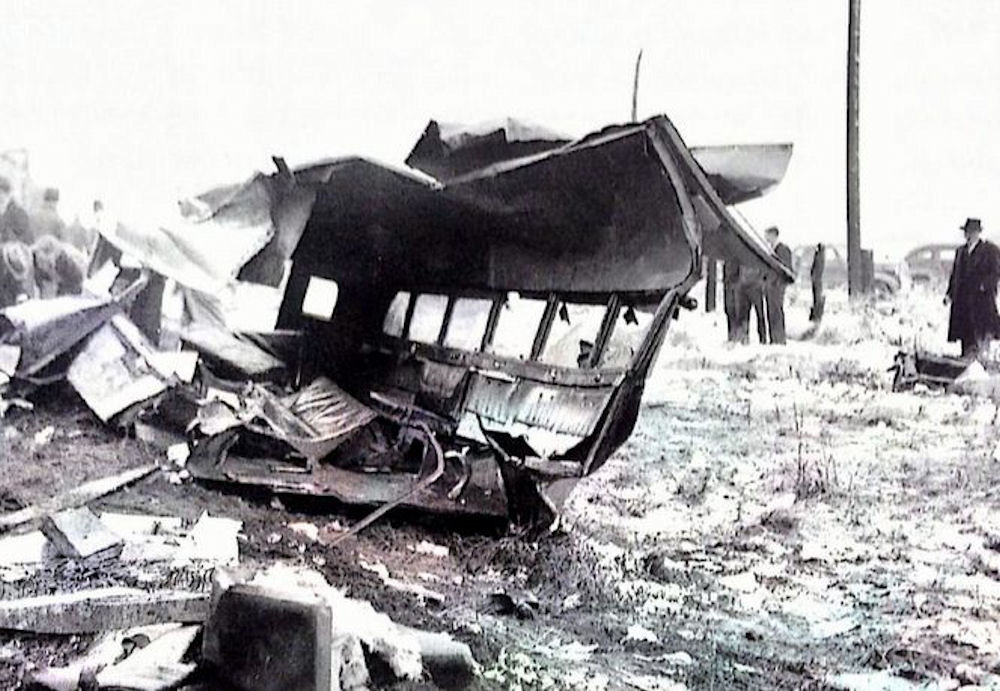
The one boy's shouted warning came at almost the same instant the bus blew apart in a deadly burst of flying metal, glass, seats, books...and kids. The right side of the bus wrapped itself around the front platform of the big steamer like a sheet wrapping up a mummy as it tore away from the rest of the body with a quick but tortured scree of ripping metal. The rest of the body ripped loose from the chassis and tumbled like a hard-kicked tin can for 101 feet before landing up-right, leaving a trail of coats, books homework, lunches, seats, and injured kids as it tumbled, looking like a bomb had gone off inside of it when it landed hard by the tracks. Most of the kids were violently ripped from their seats as the bus came apart explosively, several of them landing on the track ahead of the onrushing steel behemoth that had just slammed in to them. A couple of them were ejected through the right side windows to land on the pilot and front platform of the locomotive. Everyone was ejected and twenty-three of the kids on board the bus, along with Silcox, were killed instantly as the train ripped it apart. Two more, horribly injured, would die with-in the next couple of days. 


<********> 


The front and right side of the bus body as well as the chassis wrapped around the front of D&RGW locomotive 3708. Look behind the man in the dark hat at the extreme right of the shot, and you can see one of the bus' center seats, still mounted on the chassis. Cutting torches had to be utilized to separate bus and train.  Also you can see just how big these locomotives were here...they were huge. This is the class of big that the term 'Ginormous' was coined to describe...it's amazing that anyone survived this accident. Screencap courtesy of KSL-TV, Salt Lake City, Utah
Another view...this one, sadly, low quality...of the front of the bus wrapped around the front end of the locomotive. The still-mounted center seat is easily seen here, and it looks like one of the perimeter seats may be just visible  just ahead if it, behind the front portion of the roof. A couple of bodies actually ended up between the bus body and the front of the locomotive, on the locomotive's front platform and pilot...they were likely ejected through the right side windows of the bus.


The rear and left side of he bus body, which tumbled just over 100 feet from the crossing after being torn away from the chassis.. The entire right side of the bus body was torn away the way you'd rip the side off of a cardboard box.  Note one of the perimeter seats, still in place beneath the next to last full size window, and two of the center seats visible in the wreckage...one just in front of the perimeter seat, and a second (And possibly a third) visible in front of the open rear emergency door.

It's also possible that the rear half of the bus had been rolled upright in this pic...I found a very short YouTube vid of some news reel footage (Posted the link in 'Links') and the rear half of the bus was lying on it's side in the video.
This pic appeared in the Salt Lake City Tribune the day after the accident, and very clearly illustrates the layout of the road and crossing as well as the path of the bus. The train was northbound. The rear portion of the bus body is visible, circled, in the upper left middle of the pic. Again, it's notable that Silcox did indeed stop, but didn't take enough care to ensure there was no train before he proceeded across the tracks.

  The train slid about a half mile before shuddering to s stop, but still actually got stopped before it completely cleared the crossing...note that there are railroad cars on both sides of the crossing as the train was 'cut' to allow access from both sides of the tracks.  Given that 3708 couldn't be moved for a couple of hours after the crash...until the bus chassis was moved..., a second locomotive had to have been dispatched to both move the rear half of the train, and to continue 3708's run.

Also note how little snow was on the ground...one of several factors that handily refuted the 'Train was obscured by snow' theory. One thing that, to me, is also instantly notable. This was well into the incident, given the number of people on scene and the fact that the media had arrived...but there's not a single piece of emergency equipment visible anywhere.
<********>

 Even as the train punted the body like a football the locomotive's pilot over-rode the bus' frame rails and dragged the chassis and right side of the bus over a half mile. The bus' right side frame rail bent like cooked spaghetti as the chassis crammed itself beneath the pilot and slammed into the  locomotive's front...or pilot...truck, derailing it, the derailed wheels tearing up ties, scattering ballast like shrapnel, and digging up the roadbed until 3708 finally shuddered to a stop 2300 feet and change from the crossing, scattering bus-parts, including the entire front clip and drive-train, alongside the right-of-way. 


No one got out of this one uninjured, and the injuries, in many cases, were life-changing. I'm not sure where the first phone call reporting the accident came from...this was 1938, remember, and while the telephone was becoming more and more main-stream, only just more than  thirty percent of homes had phones. A young lady named June Winn was waiting for the bus on her front porch about a quarter mile north of the crossing, as kids have done during bad weather since time eternal. This was open country back then, remember, so she could see the crossing from her porch, and she also saw the train coming, and saw the bus ease to a stop. Knowing she had just a couple of minutes...however long it took the train to pass and the bus to cross the tracks and make it the quarter mile or so to her house...she gathered her books and started walking towards the end of her driveway, just in time to hear the 'CR-WUUMMP!! of the crash, and looked up to see the dismembered chassis being shoved down the track ahead of the train. (That absolutely had to be one of the most traumatic 'This can't really be happening' moments of all time.). 

June ran back to the house, dropping her books and screaming for her parents, and if the Winns had a phone I'd lay odds that they made the first call and if that was the case, the train could have very well still been sliding when one of the Winns picked the phone up and desperately rang for the operator.  But I've also found one source that stated that someone had to run for over a mile to find a phone, and no matter how quick that call was made, this was 1938, and prehospital care, especially for the type of injuries suffered in this accident, just plain long didn't exist at all. 

Meanwhile, as tragedy played out only a couple of miles away, seventeen year old Wanda Shields stood just inside the front entrance of Jordan High School, watching the buses roll in, specifically for the bus her BFF rode...the bus she would  have ridden if her little sis hadn't gotten sick the day before, causing Wanda's mom to nix a planned-for sleepover with her BFF because she needed Wanda at home.

Her bestie never arrived. It was still spitting snow as the first bell rang, and Wanda drifted off to her first period class, where she found her first period teacher and several students crying...one of the girls looked at her, teary eyed and said 'Oh my
God, Wanda...' Before this un-named girl could finish the thought the bell rang three or so times...the coded signal back in those pre-P.A. system days for all students to assemble in the Auditorium.  This assembly was where Wanda, and the rest of the student body found out about the crash. The principal told them that there had been a 'Horrible crash', but gave few other details, as only dribs and drabs of information had made it back to the school. He then told the kids that school was canceled for the day, and parents were called and buses recalled to pick the kids up. 

Wanda didn't know for sure that it was her best friend's bus involved in the accident...but she had a sick feeling in the pit of her stomach that was telling her that it was. This memory...recounted by Wanda when she was interviewed as the accident's 75th anniversary approached...was one of the very few references I found of any kind to emergency response to the crash.

We have to remember that this was a very rural area back in 1938, and that the U.S was still in the midst of The Great Depression, though it was beginning to ease...very slightly...by the end of the decade.  Fire departments in that area, other than Salt Lake City's, were all volunteer if they existed at all. Equipment would have been equally limited... downright primitive by today's standards...as very few Volunteer F.D.s could afford new rigs during the depression. Heavy rescue equipment consisted of railroad jacks and acetylene torches and, for the most part, was only carried by specialized rigs in the largest cities. 

  There were few phones, no radios, and notification of volunteers, where they did exist relied on the age-old 'House Siren' perched on a pole next to the fire house. But to to be very honest here, I have a feeling that there was no fire department to respond in Sandy, Utah, or anywhere closer than Salt Lake City or Midvale on that tragic December first eighty years ago. South Jordan...smaller than and hard by Sandy to the West...didn't get anything vaguely resembling fire protection until 1951, and it's telling that in the accident scene pics I've been able to find there's not a single firefighter or emergency vehicle visible anywhere...just lots of private vehicles and guys in suits.

The great majority of ambulances back then were operated by either hospitals or funeral homes and the closest ones to the scene were probably in Salt Lake City (which even back then was a teeming city of 140K residents), and Midvale, which, with just shy of 3000 residents, was one of the largest towns in the area. Ambulances were requested from throughout the region and twelve responded to the scene. Back in 1938, though, prehosital 'Patient Care' was focused on getting the patient to the hospital quickly, and very little was done in the field, so no matter how many ambos responded or where they were responding from, it would be a very basic 'Swoop and Scoop' operation once they got there.  The thirteen...out of 38...kids who survived were put on stretchers, loaded into onto one of the ambulances, and the drivers floor-boarded the big Caddies or Packards to get them to the hospital while the patient were still breathing and viable. From the period news reports I read six or eight of these kids were extremely lucky...they were treated for their injuries and released (I'm betting they were seated at the very rear, on the left side of the bus).

This was a nasty, nasty crash...At least seven of the survivors suffered critical injuries, and two of them would die before the next couple of days passed. Twenty-three died at the scene, and  many of the bodies were so badly mangled that not only did parents have trouble identifying their children, officials on scene had trouble determining just how many kids had been on the bus and who had been killed. Remember me saying just above that info was slow to arrive at JHS? They weren't even sure who was aboard the bus, and for a short while, just which bus it was. 

Once they were sure which bus was involved in the crash, figuring out just who was on the bus wasn't easy...remember, the technology we take for granted today hadn't even been thought of in 1938. The first thought that comes to mind is 'See what students aren't at school'...but such a head count at the school wouldn't necessarily be accurate because a student could be absent for any number of reasons...several of the kids who should have been on Silcox's bus, remember, missed it. Volunteers ultimately had to canvas door-to-door along Silcox's bus' route to determine who had and hadn't been aboard...and who hadn't returned home from school. And the information they tallied in that grim census was heartbreaking. As happened in Evans two decades and change later, several families lost multiple children, three families loosing two children apiece. And, also as happened at Evans, several sets of cousins were among those killed in the crash, meaning some parents lost not only a son or daughter, but a niece or nephew as well.

Of course, as parents found out about the crash, those who could descended upon the scene to search for their kids. There was absolutely no perimeter control at scenes back then...at least not as strict as it is today... and parents pretty much had the run of the scene. They either had the horrible, horrible experience of finding their childrens' bodies on the scene (Words don't even exist to describe the horror of that experience) or had to embark on that frustrating, heartbreaking search for the hospital or morgue that their child was transported to. (This lack of information available for parents or other relatives about the status of their loved ones who were involved in a major mass casualty incident...MCI in modern terminology...is a problem that hasn't been completely solved to this day). 

The investigations started immediately, of course, with one of the first investigators to arrive on the scene being Lote Kinney, who was special investigator for the Salt Lake County Attorney, and he was also one of the first to confirm that visibility wasn't overly obscured by the weather. He got to the scene about 9:15AM...just under 45 minutes after the accident...and could see a good half mile up the track in both directions. Being a sharp and intuitive investigator, one of the first questions he asked was 'Is this about what the weather was like when the accident happened?' The answer was yes. So it was pretty obvious that, had Silcox looked...I mean really looked...he should have seen Train #31 bearing down on the crossing.

Kinney didn't even have to ask about road conditions, which he knew would be questioned. He wasn't notified until at least fifteen minutes after the the accident, then had to drive to the scene from Salt Lake City...about eighteen miles distant...through the snow on the less than stellar roads of the day, and he still rolled onto the scene only forty-five or so minutes after that cataclysmic 'CRA-WHUMP!!' echoed across the beet fields. So he knew that it hadn't been snowing but so hard at the time of the crash. But he did ask (As did the ICC investigators later) to make it official. Witnesses, including several of the surviving students, noted that the road was clear, with absolutely no snow on it at all, and that the bus didn't so much as slip a single time along it's route. So road conditions played absolutely no part in the accident.

The ICC accident investigation branch...fore-runner of the present day NTSB...was just as thorough as today's organization, though they didn't have the technology that's taken for granted today to help them out.. Measurements were taken and recorded, dozens of pictures taken (Cameras had gotten pretty sophisticated by 1938) and witnesses were interviewed. They were even able to determine the train's exact speed at the moment of impact...steam locomotives were nearing their zenith of technical sophistication in 1938 (Diesels were already beginning to encroach on the steamers' kingdom by the late 30s) and 3708 had a speed register tape, integrated with it's Valve Pilot (An early fuel efficiency device), that recorded the train's speed, giving the investigators a actual readout of just how fast the train was going when it hit the bus as well as it's speed for the few minutes just preceding the accident.

The bus chassis was jammed up under 3708's pilot so tightly that torches had to be used to free it, then the locomotive's pilot truck had to be rereailed. This took time of course, and when these tasks were finished another locomotive was brought in to complete the run and 3708 was taken to the railroad's shops and gone over with a fine toothed comb. The mechanics and investigators wielding that comb found out exactly what Rehmer probably told them in the first place...that the big Challenger class locomotive was operating perfectly. There was just absolutely no way to get a fifty car freight train stopped in 200...or, for that matter, 2000...feet.

The basic cause of the accident was actually pretty easily determined...Silcox drove the bus in front of the train. What wasn't so easy to figure out...and remains unknown to this very day...was just why he drove the bus in front of the train. I have a sneakin' suspicion that this is why, as the story of the crash was told and retold over the years, the weather conditions have become exaggerated to the point that, in just about every account I've read, the storm was described as a full blown blizzard. If it was snowing that hard, that had to be the reason Silcox, who was known to be very responsible, drove in front of the train. The way looked clear when he checked, then, just as he drove onto the tracks,The Flying Ute just suddenly appeared out of a wall of falling show like some deadly wraith.

The ICC report actually refutes that cause pretty handily, but you don't even need that very informative document to see that Sandy, Utah's first snowstorm of the winter of '38/'39 wasn't anything close to a blizzard. You just need the photos that appeared on the front page of pretty much every newspaper in the US in the days after the accident. If you look at the accident scene photos, you quickly realize that it couldn't have been snowing but so hard at the accident scene, because there's just not that much snow on the ground. On top of that, as noted above, Lote Kinney stated that he could see a good half mile when he got to the scene, and as I also noted above, one of the very first things he did upon arriving was to confirm that these same conditions existed when the accident occurred.

I have a feeling that Silcox got lured onto the crossing by that same old bug-a-boo that's caused many a train-bus crash, one that can affect even the best and safest drivers...complacency. The Flying Ute should have passed Burgon's crossing almost four hours earlier, before anyone on that bus even thought about waking up. Even with Silcox starting the route early...even if he started the route an entire hour early...the train should have passed through three hours before the bus trundled onto the tracks at Burgon's Crossing.

Silcox wasn't expecting a train. He probably stopped, glanced to the right for an instant, not opening the door to preserve what little warmth the clear vision windows contributed, and, in his mind, saw exactly what he was expecting to see...no train. Unfortunately, of course,, there was a train, right on top of them, and I think Silcox did something that all of us have done while driving. Stop at a stop-sign where there's always very little traffic, glance both ways for an instant, and start moving before your brain yells 'whoa!!', making you look again and foot-stab the brakes just as the trash truck you almost missed seeing, even though it was there, trundles through the intersection. This is very likely exactly what happened to Silcox...except that, when his mind yelled 'Whoa!!' it it was a train that he missed seeing, and when he foot-stabbed the brakes, it was too late.

According to every modern account I read about the accident...most written as either the unveiling of the memorial that was erected to memorialize the victims of the crash or the anniversary of the accident approached...the laws requiring school bus drivers to stop, open the door and side window, and actively look for a train, were enacted as a result of this accident. In another eerie precursor to Evans, a track-walker was also required....in Utah...for a while until that portion of the law was repealed because of the hazard that whoever walked the crossing was exposed to.

And I have a feeling that the 'In Utah' that I noted above is a clue here. I think the more stringent laws were enacted in Utah, and possibly a few other states, but it wasn't federally mandated, nor was it quite as stringent as the laws enacted after the Spring City crash, which required drivers to silence everyone and every thing on the bus that could make noise before listening for an oncoming train.

And it's not like laws didn't already exist...there was, in fact, already a law on the books in Utah requiring school bus drivers to stop at crossings, reading as follows:

'The driver of any motor bus carrying passengers for hire or any school bus carrying children shall, before crossing any track of a railway, stop such vehicle not less than 10 feet or more than 50 feet from the nearest rail of such track, and while stopped shall look and listen for any approaching railway trains and for whistles or other warnings indicating the approach of a train, and shall not proceed until it is safe to do so'

So the basic gist of the laws we know now was already in place when this crash happened, as I have a feeling that, by that time, all of the 48 states then comprising the U.S. had a law requiring school buses to stop at railroad crossings. So this accident isn't the one that caused laws requiring school buses to stop at crossings to be put in place, nor are any of the ones that occurred later....those laws were already in place.  I did read in one source that immediately after this accident the ICC 'Strongly Recommended' that a requirement that school bus drivers not only stop at grade crossings, but also open the door to ensure that they could hear an oncoming train, be implemented and enforced. I don't know how widely this recommendation was accepted though. 

I very definitely think that each crash caused something to be added to the laws governing school buses and railroad crossings, often only in the state where the accident occurred, until the Department of Transportation finally mandated that the best features of all of the state laws be combined and tweaked, and that this standardized law be put in place in every state.

Whatever laws and safety improvements were inspired by the accident were no great comfort to the residents of Sandy, South Jordan, and environs there-of. Christmas in that then-tiny community was shattered that year as twenty three families (Three families lost two children each) planned funerals rather than Christmas celebrations, and the community suffered and mourned right along with them. Jordan High had four hundred students, Sandy had 1500 people. Everyone at Jordan High probably knew most, if not all of the kids on that bus. Everyone in the area was affected...everyone in Sandy, South Jordan, and several other small towns JHS drew it's student body from knew at least a couple of the kids on the bus. The funerals probably seemed to go on forever.


****************************************************************************

Helen Young                                                        Rela Beckstead

Helen and Rela were best friends 
 

Neal Wilson Densley                                         James Carlisle


Robert Egbert                                                   William Glazier


George Albert Hunt                                               Lois Johnson


Bayard Larson                                                        Rosa Larson


Naomi Lewis                                                             Helen Lloyd


Del Marcy                                                                   Raye Miller


Virginia Nelson                                                 Allan Peterson


Roland Page                                                         Duane Parkinson

Roland's girlfriend was also killed in the accident. 


Kenneth C. Peterson                              Harold Sandstrom  
Carol Stephenson


Ida Viola Sundquist                                       Wilbert Webb


Naomi Webb Dean                                         Leroy Winward


************************************************************************************

<***>Notes, Links, and Stuff<***>


The other posts in this series
in the order they were posted.


March 1972

October 1971

August 1976


http://disasteroushistory.blogspot.com/2015/02/conasauga-tennesee-bustrain-crash.html  Conasauga Tenn.
  March 2000

http://disasteroushistory.blogspot.com/2016/03/sandy-utah-bus-train-crashthe-worst.html   Sandy, Utah Dec 1938

http://disasteroushistory.blogspot.com/2016/03/proberta-california-train-bus-crash.html  Proberta, California Nov 1921

http://disasteroushistory.blogspot.com/2016/02/shreve-ohio-and-berea-ohio-school.html  Shreve and Berea Ohio Jan. 1930

http://disasteroushistory.blogspot.com/2016/03/crescent-city-florida-trainschool-bus.html  Crescent City, Florida December 1933

http://disasteroushistory.blogspot.com/2016/03/rockville-md-train-bus-crash-april-11th.html  Rockville, Maryland April 1935

http://disasteroushistory.blogspot.com/2016/03/mason-city-iowa-bus-train-crash.html  MAson City, Iowa Oct. 1937

http://disasteroushistory.blogspot.com/2016/03/eads-tennessee-trainschool-bus-crash.html Eads, Tennessee Oct. 1941


<***>

I'm doing the same thing with the second half of my 'School bus/Train crash' series of articles that I did with the first half..starting with the worst and most infamous of the bunch, then taking the others in chronological order. And I'm kind of working backwards while I'm at it...the first half of the series covered 1955 to the present, while this set of posts covers 1920 or there-abouts to 1954.

Not only is the Sandy bus crash the the worst of the accidents covered in this set of posts, as noted above, it was the worst school bus-train crash, and the worst crossing accident in U.S. History. That being the case, you'd think that there would be all kind of accurate information on-line about this one. Guess what, gang...ain't the way it happened.

Oh, there are loads of articles out there. Problem is, a lot of the basic information's just dead wrong. The majority of the articles I found were written as the date of the unveiling of a monument to the crash victims approached, and all of them...Every. Single. One....repeated the 'Train Suddenly Appeared Out Of The Blizzard' story. A couple of them had the number of cars on the train wrong. The speed at impact varied from the correct '50MPH' (OK, it was actually 52, but at least they were close) to 60MPH. The articles couldn't even agree on the number of fatalities, ranging from 23 (The original reported number of deaths at the time of the accident) to 27 (One more than actually died). Making things even more difficult, I had trouble finding any contemporary articles about the crash, even coming up dry at the Genealogy site that I use as one of the base sources for subjects for my blog, and That really surprised me.

By sheer luck I ran up on a link for an archive of old, old ICC/NTSB reports, going back to the very early part of the 20th century, and while every report of every accident that was investigated in the century and change span covered by the archive isn't in the archive, this one (As well as a couple of others I was looking for) was. Thanks to that chance finding of a link to an archive of ancient Interstate Commerce Commission accident reports, this post is hopefully accurate...or as accurate as I could make it at any rate.

Then, with a little bit more research and with the help of the great cyber-know-it-all, Google, I finally found a couple of archived newspaper articles that gave me a few more facts...such as the engineer's and fireman's first and last names...not included in the ICC report...allowing me to make this a bit more than a couple of paragraphs of maybe-facts and lots of speculation. Oh I speculated a bit...it's one of the things I do. But I really do like to include at least a few actual, accurate facts in my posts as well.

Though the basic info wasn't accurate in the modern articles, they did contain a couple of pretty awesome human interest stories, which I'll relate below...So lets do the notes...


<***>

It took a quarter century for a memorial to be erected in honor of the victims of the crash. I couldn't find a whole lot of information about just why it took so long for these kids to be memorialized, but when it was finally done, it was done right.

The monument is a ten foot polished marble obelisk, located at Community Center/Heritage Park, 10778 S. Redwood Road in South Jordan, and has brass plaques at the base telling the story of the crash and naming all 39 students who were aboard the bus. Sadly, I couldn't find a good picture of the memorial


<***>

Remember Virginia Nelson's English homework? That page or so of verb problems ended up being a story of it's own. Her little sister now has a scrap that's all that remains of that homework...but it's a scrap that has Virginia's name on it. And she didn't get it back for 75 years.

Joyce Nelson was devastated by her big sister's death. I believe Joyce was in elementary school when Virginia was killed, and she found out about the accident and the death of her sister through what she probably thought was going to be a pleasant surprise...seeing her parents swing into the school driveway early in the day, then seeing her mom or dad at the classroom door, getting her out of school way early. Puzzled jubilation, sadly, quickly gave way to devastation...and she's missed Virginia ever since. Her big sis had always had her back, had always been someone she could look up to and ask for advice, had been her partner in crime, sounding board, and confidant...and now she was gone. Christmas didn't even exist that year. The tears have lasted for 75 years.

A handsome kid named Carol (Pronounced as if it were 'Carl' ) Stephenson,  who looked like he had just a spark of good natured mischief in his eyes, and who was probably seriously popular with the ladies of JHS...he just looked the type...was also killed in the crash. His parents possibly picked the scrap of homework up at the scene while looking for any of his possessions that may have been scattered along the tracks. The scrap of homework ended up in a box of Carol's possessions that Stephenson family kept to remember him by, and this box was passed down through the years until it came into the hands of Carol's niece, Caroleen, who was born some years after his death. She had looked at this scrap of homework numerous times, keeping it even though it had nothing to do with her uncle, because, after all, it belonged to one of the kids who was killed in the accident, very likely a friend of Carol's, and besides....it would mean something to someone. Problem was, there was really no way to easily find out just who. Nearly three quarters of a century had passed. The survivors of the accident would all be in their late 80s or early 90s. People had married, moved, and passed away in the intervening 75 years. Still, she hung onto it, hoping that somehow, she could get it to a relative of the young lady who'd originally finished it...

Then, as 2013 drew to a close, the accident's approaching 75th anniversary inspired another round a of articles, one of which announced the unveiling of the memorial on Dec 1st, 2013. Caroleen decided to make the three hundred or so mile trip from Glendale, Utah to attend the unveiling in order to honor her uncle...and hopefully find someone in Virginia Nelson's family to give the homework paper. It was, she knew, a fairly remote possibility.

Virginia Nelson's long lost homework assignment.

...With her name still legible at the top of the page.
 Both pictures courtesy of KSL-TV Salt Lake City, Utah.


After the monument was unveiled, the names of the victims were read off and as Virginia Nelson's name was read off a still very spry older lady stood. Caroleen made her way over to her and asked her if she had been related to Virginia Nelson. The lady..Now Joyce Holder, formerly Joyce Nelson...told her that why, yes, Virginia had been her older sister.

Caroleen held out the tattered homework paper, now protected in a plastic bag, and said 'I believe this was your sister's. Tears appeared in Joyce Holders eyes as she saw Virginia's name on the still very readable page. She had idolized her big sis, still missed her to that very day. Now she had something tangible...something that Virginia had actually handled...to remember her by.

Of course that wasn't the end of the story...Caroleen had a 300 mile drive home ahead of her, and wanted to get on the road, so she told Joyce that she was so glad she'd found her, wished her well, and said she had to get on the road. Somewhere in there she never introduced herself. Joyce set out on a mission of her own...to find the person who returned Virginia's homework to her. Of course, that was far easier than Caroleen's search for her had been, because the story was published statewide, and Caroleen saw one of the articles, got in touch with Joyce, and introduced herself.

Somewhere, in Heaven, an angel named Virginia's smiling down on her little sis, and saying 'Hey, I've always had your back, Sis...I'm still with you'. And, being eternally fifteen, she's looking at that homework paper and thinking 'Shoot...I'd've aced the thing, too!!!'


<***>


One of the many tragedies of a young person's death is the lost potential...there is no way to regain that potential, or to know just what contributions to society that person may have made. One of the best illustrations of this from the Sandy, Utah accident is the poem that seventeen year old Naomi Lewis penned the night before the accident, possibly for a homework assignment, that I've included below.


"Earth's Angels"
I like to think that wind
Is angels in the trees,
Stately noble angels
That no one ever, ever sees.
When the world is peaceful
And people are living right,
They rustle the branches gently
Throughout the entire night.
But when the world is wicked
Then sorrow bursts from the trees.
And it sounds like the wailing,
Woeful hum
Of hostile, atrocious bees.
But in my imagining
It's angels sorrowing in the tree.
At night they call a council
Of angels on the earth,
Each angel chooses a mortal
To guide to his preordained worth.
So I like to think that wind
Is angels in the trees
Stately, noble angels
That no one ever, ever sees.
Naomi Lewis, age 17, penned the night before she died in the bus/train wreck.

<***>


The only thing worse for parents than the nightmare of loosing a child is loosing more than one child at the same time. Three sets of siblings were among those killed in the accident. It could have been even worse...there were also three sets of siblings among the survivors.

The horrible phenomenon of loosing several sets of siblings in the same accident has just become possible within the last century and change. It's occurred in multiple school bus accidents (And not just accidents involving trains) over the past 120 or so years, and happened in the second worse train-school bus collision (The one in Evan's Colorado, in December 1961) as well. It's an occurrence that's too horrible to even contemplate...but than again the death of any child is as well.

<***>

Speaking of the Evan Colorado Accident, The Sandy and Evans accidents, separated by twenty-three years, share a striking number of similarities:

>Both occurred in December, in small towns in the Western U.S.
>Both occurred in the morning,while the bus was on the way in to school.
>There was snow on the ground at both scenes.
>Both occurred at unsignalled crossings.
>The chassis of both buses were built by GMC (Known as General Motors Truck Corp back in The Thirties)
>The bus windows were fogged over in both cases
>The driver actually did stop the bus short of the crossing in both cases...then proceeded after not seeing the oncoming train.
>A passenger sitting in the front seat of the bus saw the train and shouted 'TRAIN!!!' an instant before the collision in both accidents.
>In both accidents the driver was known to be very responsible, making it all the more puzzling that he drove in front of a train.

<***>

While there is some dispute over which accident prompted what laws to be enacted at what point in time in which state, one thing that the Sandy accident did inspire was national talks on warning devices at railroad crossings. The flashing red light signal was actually first developed in 1913...about the same time flashing red warning lights began appearing on emergency vehicles, and actually a year before the Wig-Wag signals discussed in the article on the Stratton Nebraska crash were first put in use...but it was nothing like the alternating light RR warning signals we're so familiar with. It consisted , very likely, of a single flashing light (Paired with an electric bell) mounted high on the pole, above the cross-buck sign. The alternating light signal was developed in the thirties, as was the automatic crossing gate. The alternating light signal really began taking hold in the late Thirties to early Forties, and the Sandy, Utah accident is the one that caused their development and implementation to be pushed. The wild thing is, though, to this day, there are still unprotected crossings, especially in very rural areas.

<***>

This wasn't the only train/school bus crash in the Salt Lake City area during The Thirties, and the other one I found was unusual in a couple of respects.

Apparently school buses were picked up at the factory and driven home by their assigned drivers back in the thirties, at least they were back then in Utah, and that's exactly what Issac Draper did in late Feb/early March of 1935, just shy of three years before the Sandy bus accident. He traveled to Detroit...probably by train...and picked up a brand new bus, driving it back to Mapleton. Keep in mind here that this was 1935, and while the highway system had advanced by leaps and bounds over what it had been even just twenty years earlier, there were no interstates, and few multi-lane highways...the great majority of highways were two lane roads, so it was probably a multi-day road trip adventure.

On the evening of March 2nd, 1935, Draper was drawing close to home in Mapleton...about 40 miles south of Sandy and straddling the same line of the D&RGW that the Sandy accident had occurred on. He stopped to visit his daughter for a few minutes, probably also using the break to stretch his legs for a bit, then headed for home, only a few miles and about twenty or so minutes distant. In order to get to his home, west of Mapleton near Genola, he had to cross the D&RGW tracks, at the crossing hard by the Mapleton railroad station. A D&RGW passenger train...one not scheduled to stop at Mapleton...was approaching the crossing at the same time Draper rolled up on it. Now, having no kids on board, Draper wasn't required to stop at all, but it would seem to be common sense as well as instinctive self-preservation to do so anyway. But then again, he'd just driven a school bus over 1000 miles. He was probably tired as hell of, as the classic 70s song states, 'The engine droning out it's one lone song'. He was tired in general. He wanted to get home and prop his feet up on something that wasn't moving. The bus was closed up tight, so he apparently didn't hear the whistle. And the train was hidden by the station as he rolled onto the crossing.

The bus just suddenly appeared from behind the station and the train's engineer didn't even have time to dump the brakes before they hit the bus, wrapping it around the front of the locomotive, then scattering bus parts for 1150 feet as the train, it's brakes locked after they hit, slid, the shattered bus tearing out cattle guards on both side of the tracks as it was dragged. Draper's body was thrown clear 450 feet from the crossing. Weather conditions were clear, but Draper was probably about ready to drop, and probably daydreaming about being home and sleeping in his own bed. Investigators determined that Draper's view of the approaching train was obscured by the station, and that his fatigue was very much a contributing factor in the crash.

Sadly, Draper, who farmed as well as driving a school bus, left behind a huge family...a wife and nine kids (Six sons and three daughters). The crossing where the accident occurred was, of course, unsignalled.

<***>


Though Sandy grew in leaps and bounds over the past nearly eighty years, and the road system and street layout changed completely, the crossing where the Sandy bus/train crash occurred remained in place until 2002. The crossing had been upgraded to include signals decades earlier by that time of course, but accidents still managed to occur there, with the last fatality occurring on New Years Eve 1995 when three teens were killed when they tried to beat the train. The last accident to occur there was in 2002, just before the crossing was removed, when the driver of a pickup ignored the signals and drove onto the crossing.


<***>


The original Jordan High School...the destination that the bus never reached...has an interesting story of it's own. Some of it still exists...as a movie theater.

The original building was built in 1914, and would ultimately be included on the National Register of Historic Places. It was a immense solid two story brick structure with an English basement,..pretty much the traditional vision of 'Early 20th Century School Building'...and actually had a good bit more capacity than needed when opened.

The building was in use from 1914 to 1996...82 years...and was finally replaced with the current building, located only a mile or so away, when it became sorely apparent that it was now far too small...despite additions over the years...and that it was really beginning to show it's age.

The building's issues had been becoming...well...issues for years, and the building was almost replaced in the mid Seventies...as in a replacement school was actually in the early stages of construction, but the school district looked at the student population and projected growth of same, realized that they actually needed a new school as well as Jordan high, and what would have been New Jordan High became one of JHS biggest rivals...Alta High School.

The new Jordan High was finally built and opened in 1996, with a capacity of 2600 students and was one of the nicest school buildings in the nation. And...just to show that 'Be True To Your School' is more than a Beach Boys song, when the school district asked the student body if they wanted to change the school's mascot, colors, and logo to reflect their new digs...

OK, Jordan High's sports teams have been 'The Beetdiggers, in honor of the areas beginnings as one of the primary sugar beet growing regions in the nation, since 1914. The colors have been Maroon and Gray for the same period of time. The general consensus was something to the effect of...

 'Really?? Really, Dudes??? Are you freaking kidding???...No we don't want to change any of the above!!!'

  Beetdiggers they were, and Beetdiggers they stayed (And still are). They tend, from what I've read, to field gridiron powerhouses every fall.

But what of the old building? Being a truly beautiful building on the National Register of Historic Places, you'd think something would have been done with it, and it was...sort of. When a guy named Larry Miller bought the old school and property, he did so so he could build and promote one of the Salt Lake City areas biggest entertainment and shopping venues...Jordan Commons. When the old building was torn down, the front entrance facade was saved and incorporated into the main entrance of Jordan Commons.

Old Jordan High School's entrance facade...steps and all...was used as the entrance to the Jordan Commons Megaplex theater complex, built on the site of the old school. Old Jordan high School's shown in the inset for comparison.  The developers did a pretty decent job incorporating the entrance facade into the modern building, but I still think it would have been far better if the old school itself could have been preserved.

<***>


JHS being the destination never reached, and the accident being the worst crossing accident in US History, there are a few ghost stories attached to the old school. Supposedly seven chairs would be found formed into a circle in the cafeteria...when the chairs were put back where they belonged, they'd be discovered an hour or so later, back in the circle. Voices had been heard in the band room and in one of the girls' restrooms when there was no one around. Ghostly apparitions were seen in the halls. All were, apparently, benevolent spirits, and a couple of them apparently made their way to the theater complex as well, as the vision of a lady and teen age girl talking have been seen by maintenance and housekeeping personnel in the mall in the area that would have been the very hallway where this same pair of apparitions  was seen several times when the school was still open. They haven't yet made themselves known to shoppers, however.

There's another, far more famous ghost story that the crash may have helped create...but that's a story for another post.


 <***>LINKS<***>


As I noted a couple of times in this post, there were a slew of articles about the accident out there, but the ICC report makes their accuracy somewhat suspect, with the time-worn 'The Train Appeared Out Of A Blizzard' story being the part of the story that the report most decisively debunked.

First up...the archived ICC report...it's also down loadable as a PDF file. You'll need Adobe Reader or similar PDF reader to view the PDF version:


http://www.galecenter.org/exhibits-busaccident.asp The Gale Center of History and Culture has an extensive exhibit about the accident, including a lengthy and informative video about the accident, as well as the story of Naomi Lewis' poem

http://tinyurl.com/kp2q5jd Desert News article about the accident.

http://tinyurl.com/mkyhql3 Salt Lake Tribune article about the accident...Wanda Shields story is included in this article, as well as a discussion of modern school bus safety.

http://www.findagrave.com/cgi-bin/fg.cgi?page=vcsr&GSvcid=103074 Find A Grave page about the accident.

https://www.youtube.com/watch?v=CgYuzbiN83s A quick YouTube video from Critical Past, with archived news real footage of the scene. There are several views of the rear half of the bus

KSL TV in Salt Lake City broadcast a series of segments on the accident and it's aftermath, all of them pretty decent, though all do indeed include the 'Blizzard':

http://www.ksl.com/?sid=27814442 KSL article and video about the memorial...several interviews with survivors and relatives of survivors are also included, as well as a photo gallery. The map included in the article is of the memorial site, not the accident site.

http://tinyurl.com/kvmc979 Quick article about the unveiling of the memorial.
http://www.ksl.com/?sid=27982346 Article and video about the return of Virginia Nelson's homework to her younger sister...An interview with Joyce Nelson Holder is included. The video is far more moving than the short bit of text I gave it here.

http://www.ksl.com/index.php?nid=148&sid=28008687 Article and video about the lady who returned the homework.